
Theory
Reflections on the Probationary Citizen
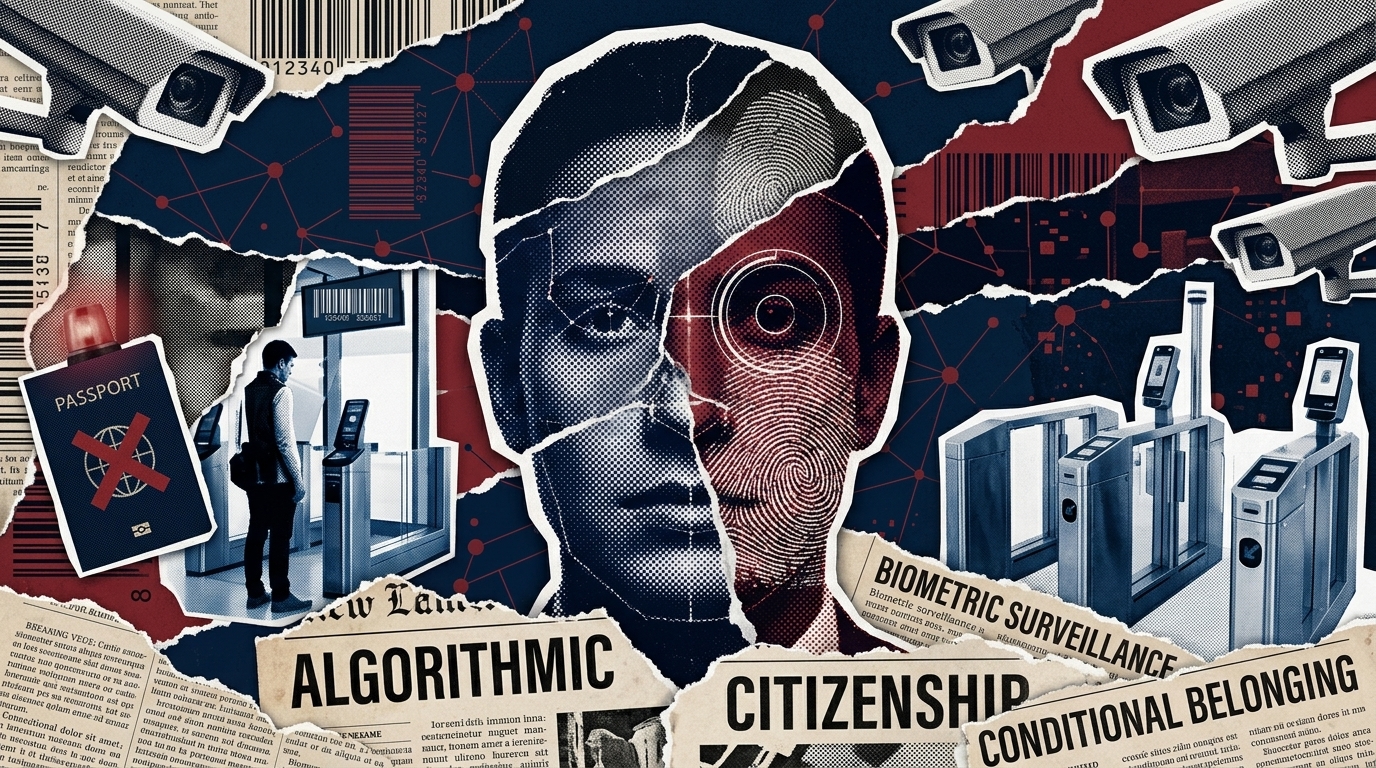
Algorithmic surveillance has turned citizenship into “probationary freedom,” forcing us to continually validate our identity in front of machines that cannot be reasoned with.
https://conciencia-democratica.org/articulos/reflections-on-the-probationary-citizen?lang=enBy Mariana Puente LeraNovember 19, 20269 min read
Most of us have had some version of this experience. We arrive at an airport after a long flight, passport in hand, and join the queue for the automated gates, which promise to spare us the dignity of talking to a human being. We place the passport on the glass, look into the camera and wait. Nothing happens. We are then asked to remove our glasses, then to stand on the painted footprints, then to look up a little. Still nothing.
Eventually a red light appears, and we are directed to the one staffed desk at the far end of the hall, where an officer compares our face to our photograph with the expression of someone who has, undoubtedly, done this procedure no less than five hundred times that same day. We are, of course, exactly who we say we are. We were the whole time. The only matter in doubt was whether the machine would concur.
This episode is trivial, and most people forget it before reaching the baggage carousel. Though, it requires more attention, because it condenses a transformation in the meaning of citizenship that is proceeding so gradually, and in so banal a register, that it largely escapes notice.
For most of the modern era, citizenship functioned as a status: one possessed it, and the State was obliged to act accordingly. It is increasingly coming to resemble a form of probation. One holds it in principle, but must demonstrate that one holds it repeatedly, to systems that have no knowledge of the person before them, cannot be reasoned with, and are indifferent to explanation.
Anthropologists have long regarded the official account of citizenship with a degree of skepticism. Political philosophy and constitutional law tend to define it through rights, statutes and formal entitlements, and these definitions are not mistaken so much as incomplete. James Holston's research in the auto-constructed peripheries of São Paulo found that Brazilian citizenship was universal in its legal form yet unequal in practice, with poorer residents routinely required to produce documents, proofs and permissions that wealthier citizens were never asked for. He named this arrangement "differentiated citizenship".
The broader conclusion, shared across much of the discipline, is that citizenship is less a possession than a relationship, renewed or withdrawn in the everyday encounters through which people present themselves to institutions. Rights, in practice, are only as reliable as the official who administers them.
The change in this arrangement in our modern world is the nature of this official.
A long historical view helps clarify this. It is a revealing, and somewhat humbling, fact that the earliest known writing, the proto-cuneiform tablets of Uruk in southern Mesopotamia, recorded neither myth nor law but accounts: quantities of grain, livestock, beer rations and labor owed to temple administrators. From its earliest origins, the State has been engaged in enumerating people and their possessions.
James Scott famously described this as the pursuit of "legability". In Seeing Like a State, he showed how censuses, cadastral maps, property registers and permanent surnames served to translate the dense, local and idiosyncratic texture of social life into standardized categories that a distant authority could read, tax or conscript.
Less frequently remarked upon is how poorly states performed this task for most of their history. Enumeration was laborious. It required clerks, materials and arduous journeys, and its results were often obsolete by the time they were consulted. Even the most ambitious surveillance apparatus of the XX century, that of the German Democratic Republic, achieved its reach only through an extraordinary expenditure of human labor: by 1989 the Stasi relied on nearly 190,000 informants and had accumulated filed extending across more than hundred kilometers of shelving. The system was menacing, but it was also, by any technical measure, grossly inefficient.
It is possible to argue that much of what liberal societies came to regard as privacy was never primarily a principle at all, rather a by-product of administrative limitation. The State refrained from observing everyone largely because observing everyone was beyond its capabilities.
That limitation has now been (almost) overcome. Automated facial recognition can attach a name to a face in less than a second. India's Aadhaar program has enrolled the fingerprints and iris patterns of more than 1.3 billion people and now mediates their access to food rations, pensions, banking, and telecommunications. Private firms have assembled databases of tens of billions of images scraped from social media and sold access to police agencies across several continents. Predictive systems trained on purchasing behavior, mobility and social networks generate risk assessments of individuals who have committed no offense. The decisive change here here is economic before it is technical. Observation has become almost costless, and a system that costs little to operate has no intrinsic reason to cease operating.
What these systems do observe, however, is not the person as liberal theory conceives them. In his 1938 Huxley Memorial Lecture, Marcel Mauss argued that the "person", understood as the bearer of a name, a legal identity, a moral conscience and rights, is not a universal given but a historical construction, elaborated differently across societies and epochs. Contemporary surveillance, I would suggest, is producing a new variant of this.
The person recognized by algorithmic systems is an aggregate of fragments: a fingerprint, a facial template, a postcode, a credit history, a pattern of communication, a list of contacts abroad. These fragments are held in separate databases by separate institutions and subsequently recombined into a profile that acts in the individual's name.
Marilyn Strathern's account of Melanesian personhood, in which the person is conceived not as a bounded individual but as a "dividual" composed of partible relations, offers a suggestive if imperfect analogy. This analogy has limits, since the Melanesian dividual is constituted through reciprocity whereas the data subject is constituted through extraction. This composite figure may be approved for credit, flagged for investigation, admitted at a border or refused a benefit, frequently without the human being whose name it bears ever learning of the decision.
The result is a near schizoid duplication. For official purposes, there are now effectively two of each of us, and the one that usually counts is the one we have never encountered—and never will.
How have such systems advanced with so little public contestation? James Ferguson’s study of development program in Lesotho supplies a useful framework. Ferguson characterized the development apparatus as an "anti-politics machine": a mechanism that reformulates political questions as technical problems, delegates them to experts, and in doing so expands State power while removing its exercise from democratic deliberation.
Algorithmic governance may be the most efficient anti-politics machine yet devised. Questions that properly belong to public debate (who merits suspicion, whose movements should be recorded, how many wrongful identifications are tolerable) are recast as questions of accuracy rates and error thresholds and assigned to engineers and vendors. The political substance of these decisions is now relocated to sites where citizens possess neither standing nor vocabulary to contest it.
A further irony deserves note. Digital technologies were promoted, in considerable part, as instruments of liberation from bureaucracy, promising an end to queues, paper forms and obstructive officials. But the opposite has happened, as it usually happens when market reforms designed to reduce bureaucracy tend to multiply them. Paperwork has become continuous and imperceptible, and citizens have become permanent applicants.
The effects on political life are difficult to quantify, since they consist largely of actions that are never taken. A survey by the European Union Agency for Fundamental Rights found that nearly three in ten respondents would be less willing to attend a peaceful demonstration if facial recognition were in use. The right of assembly thus remains constitutionally intact even as its exercise quietly diminishes. Parents advise children which online spaces to avoid; activists leave their phones behind; ordinary citizens develop a diffuse but persistent sense of which opinions are better left unexpressed. Pierre Bourdieu’s concept of "habitus", the durable dispositions through which social structures become embodied as second nature, describes this process with some precision. Surveillance attains its fullest effect once it becomes habitus, when individuals modify their conduct in anticipation of observation and no explicit prohibition is any longer required.
This is not to suggest that populations are merely passive. During the 2019 protests in Hong Kong, demonstrators used umbrellas to obstruct cameras and directed lasers at their lenses. Artists and activists in Europe developed facial camouflage intended to defeat recognition software. San Francisco and several other American cities prohibited police use of facial recognition following sustained local campaigns.
Increasingly, individuals also articulate claims in their capacity as data subjects, demanding access to their records, the correction of errors and the right to contest automated decisions. An adequate account must also acknowledge that many people experience surveillance as protective rather than threatening, and ethnographic method requires that such testimony be taken seriously. It equally requires asking whose security is being produced. The resident reassured by a camera on the corner and the adolescent repeatedly stopped because of it frequently inhabit the same street.
Hannah Arendt defined citizenship as “the right to have rights,” a formulation she developed through reflection on the stateless refugees of the interwar period, who discovered that their abstract humanity afforded them no protection once political membership was withdrawn. The present predicament differs from the one she described, and is in certain respects more insidious. The principal danger is no longer expulsion from the political community but conditional inclusion within it: a membership that remains formally secure while access to its protections depends on whether an automated system is prepared to recognize the individual concerned. One may remain a citizen and still be refused at the ration shop, detained at the border, or discover that rights guaranteed on paper dissolve the moment the system determines that one does not quite compute.
It is essential, finally, to resist the temptation to treat these developments as inevitable. Technological change is frequently represented as a quasi-natural force, something that befalls societies rather than something they choose. Yet every camera was installed by someone, every database commissioned by someone, and every decision to interpose an algorithm between a citizen and her rights was taken by people who could have decided otherwise.
Mauss insisted that the category of the person is a historical achievement, which means that it can be constituted differently. The same holds for the State and for the machines through which it now perceives its members. The decisive question is therefore not whether these systems can be made more accurate, but whether democratic societies are willing to accept an order in which belonging must be continually proven to an authority that cannot be argued with, and, should they refuse, what institutional forms of recognition they are prepared to build in its place.
Share
For Instagram: copy the link and paste it in your story or DM.
Continue with
Theory
The Revolutionary Mirage?
What happened during the uprisings of December 2010 and January 2011?
Mortadha Ghaliounji

Theory
What's a rabbit?
A rabbit crosses the field and seems to leave no doubt, until Quine asks what we really saw and philosophy makes the animal a problem. Among words, classifications and essences, this essay examines the moment in which a useful category stops describing concrete organisms and begins to populate the world with an additional entity called bunny.
Agustín Cosso
Theory
From Social Democracy to the Third Way
The German SPD, the British Labour, the French Socialist Party, the Turkish CHP: one current, a thousand faces.
Mortadha Ghaliounji
Comments
No comments yet. Open the conversation.
Sign in to comment. Sign in