
Index
- The Battle of the Words
- The Orientalism of Jasmine
- Two Views on the "Tunisian Revolution"
- The Coup d'État Narrative
- The Palace Coup Theory and the Role of the Security Apparatus
- The Foreign Hand
- Judging the Confiscated Uprising
- Aziz Krichen's Critique
- Peter Calvert's Criteria
- Thinking the Revolutionary Process
- The Revolutionary Situation versus the Revolutionary Outcome
- Political Revolution versus Social Revolution
- The Rupture of the Security Pact and the Trap of the Social Question
- The Collapse of Béatrice Hibou's Security Pact and the Outbidding by the New Elites
- When Misery Paralyzes Revolutions
- The Trap of Post-Revolutionary Failures
- Dismantling the Coup d'État Thesis
- The Coup Model Confronted with January 14
- Michel Dobry and Conjunctural De-sectorization
- The Mirage of the Blank Slate
- The Original Sin of the Second Republic
- On the Disconnection of the Elites
- The Rise of the Restorative Narrative
- The Bonapartist Moment
- Bibliography
Theory
The Revolutionary Mirage?
What happened during the uprisings of December 2010 and January 2011?
https://conciencia-democratica.org/articulos/el-espejismo-revolucionario?lang=enBy Mortadha GhaliounjiAugust 28, 202624 min read
In-depth reading
To understand what happened in Tunisia since 2011, we must begin with a seemingly simple question: What happened during the uprisings of December 2010 and January 2011? A revolution? An intifada? A mere regime change? Or, as some later argued, a coup d'état?
Behind this linguistic subtlety lies a debate about the nature of these events and their political consequences. This article, the first in a series of four analyses, revisits this battle of narratives and seeks to understand how the way in which the events of 2010–2011 were named contributed to shaping and, subsequently, limiting the Tunisian transition.
The Battle of the Words
The Orientalism of Jasmine
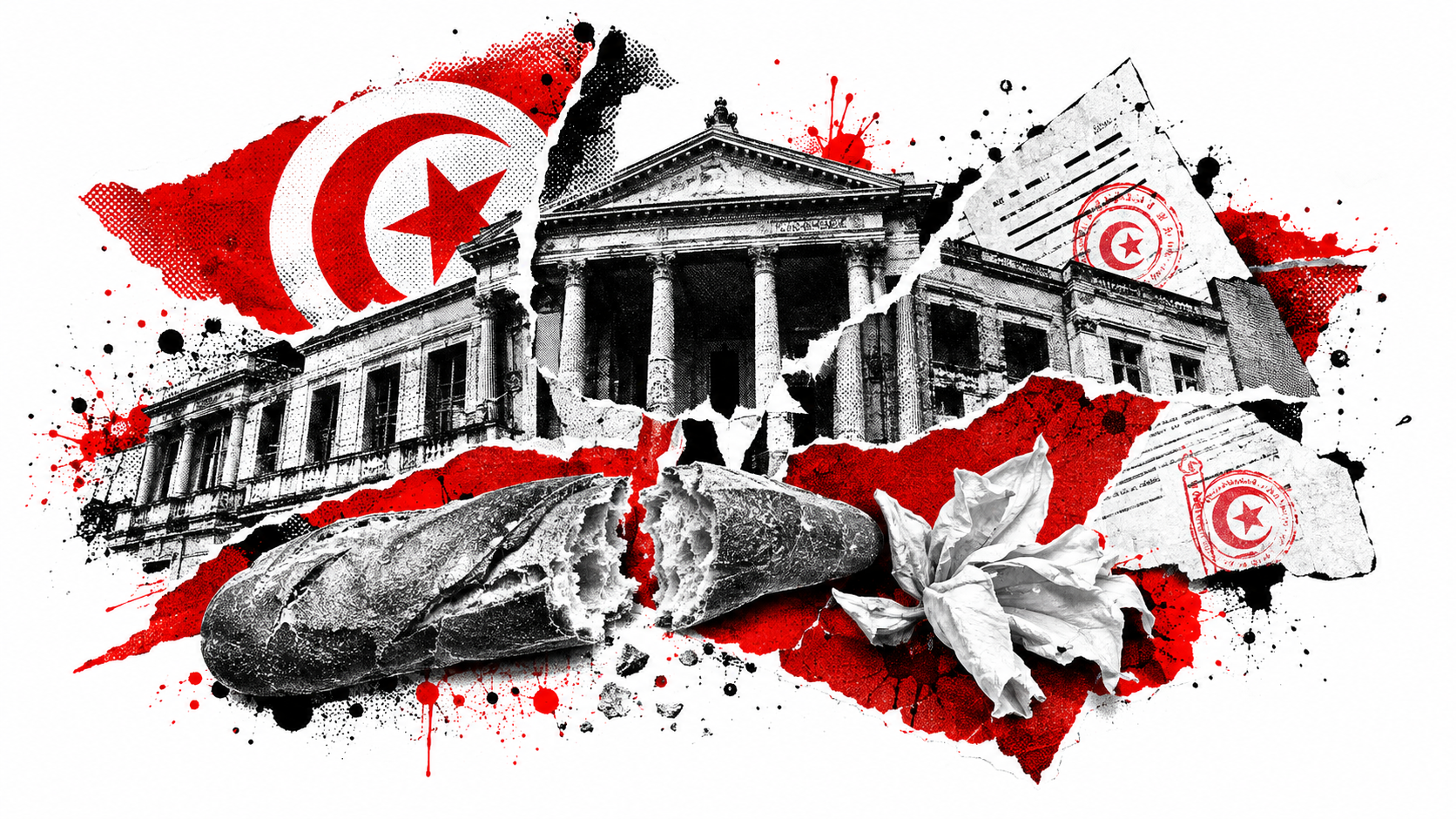
The day after January 14, 2011, Tunisia found itself embroiled in a semantic dispute aimed at qualifying the exact nature of the protest movement that had manifested itself between December 17, 2010 and January 14, 2011. The expression that prevailed in media coverage was the almost poetic "Jasmine Revolution."
This floral metaphor was not, however, new: it had already been briefly sketched to classify the "medical coup" of November 7, 1987, by which Prime Minister Ben Ali deposed President Bourguiba. But at that time the term had failed to take root in the popular imagination.
It was not until January 2011, following its lightning-fast spread on social media (both inside Tunisia and abroad), that the expression took on a second life to designate the popular uprising, before becoming the canonical name for the fall of the regime.
However, this floral label, like that of the "Arab Spring," has met with strong reservations: it is reproached for disguising harsh reality under imported concepts indebted to a certain orientalism. The jasmine, with its connotations of purity, sweetness and harmony, evokes the velvet and relatively peaceful transitions of Georgia (Rose Revolution) or Portugal (Carnation Revolution).
Yet this sweetened reading contrasts with the tragedy lived on Tunisian soil, where repression claimed hundreds of lives and left thousands wounded. For this reason, popular consciousness largely replaced it with the expression "Revolution of Dignity" (Al-Karama), more in keeping with the moral and social demands borne by the movement.
If the existence of a "Tunisian revolution" initially enjoyed broad consensus, this unanimity was soon shattered, as in the months and years following January 14, the controversy spread to all theoretical fronts: historical, by questioning the accuracy of the account of events; sociological, by evaluating whether the structural transformations of the state validated the concept of revolution; philosophical, by inquiring whether the original intention of the insurgents had been distorted; and legal-political, driven by the remnants of the old regime, who question both the legal legitimacy and the effectiveness of this transition.
Two Views on the "Tunisian Revolution"
Two main positions have emerged from these controversies.
The first absolutely denies the revolutionary fact, seeing nothing in it but a coup d'état. The second grants the sincerity of the uprising, but asserts that its purpose was shipwrecked in a confiscation.
These readings were dismissed by the coalition in power during the transition under the convenient label of mere "counter-revolutionary" drifts.
While it is undeniable that some of these analyses were forged by associates of the old regime in order to weaken the construction of the Second Republic, it would be misleading to attribute all these questions to a simple enterprise of malice.
Therefore, it is necessary to examine these theses for what they raise, without rejecting them entirely on account of the political positions of their authors, while remaining attentive, at the same time, to the political biases that may have influenced their interpretation of events.
All the more so since it is precisely by dismissing these arguments with contempt, refusing to discuss them, that they insidiously take hold and gradually come to stand as indisputable truths in collective memory.
The Coup d'État Narrative
The Palace Coup Theory and the Role of the Security Apparatus
The first thesis, which denies any revolutionary dimension to January 14, approaches these events through the prism of the coup d'état.
While it concedes that Sidi Bouzid and its surroundings were indeed the scene of popular protest (described at the time as an "intifada"), sometimes sincere and sometimes manipulated, it refuses to see in it a revolutionary process.
For the supporters of this reading, the proof of the coup d'état lies in the opacity and grey areas surrounding the behind-the-scenes workings of that decisive day.
Accounts from senior officials of the time and testimonies from those in the presidential circle sometimes suggest that the fall of the regime was less the product of a popular tide than the result of decisions by the security apparatus.
At the center of this political sequence is the role of Ali Seriati, then Director General of Presidential Security, accused of having persuaded President Ben Ali to board the presidential aircraft bound for Jeddah, Saudi Arabia, to protect his family, with the intention of returning the following day. This journey sealed, however, the president's fate — he would never return to Tunisia.
This journey with no return led numerous actors, including Akram Azouri, Ben Ali's lawyer, to denounce a military and security conspiracy orchestrated from beginning to end.
According to this thesis, the security apparatus deliberately staged and dramatized fictitious threats (the encirclement of the presidential residences, the overflight of a suspicious helicopter, the approach of maritime vessels, and an imminent assassination plot by a member of his close guard) with the sole aim of generating panic in the head of state and forcing him into exile.
For his part, Seriati defended himself by recalling that an informational chaos existed which meant the day was governed by panic and paranoia.
He himself is convinced that a coup d'état was taking place.
The first alarm signal sounded at Tunis-Carthage Airport, where the commander of the Counter-Terrorism Brigade, Samir Tarhouni, took the initiative of intercepting and detaining members of the president's wife's family before they could flee.
This detention, carried out by an elite unit, was perceived by Seriati as a sign that he could no longer guarantee the protection of the presidential family, which, combined with rumors of suspicious helicopters or boats around the palace, accelerated the panic.
The machinery accelerated immediately after the plane's departure: the declaration of a power vacancy by Mohamed Ghannouchi on television, followed by the declaration of the national army, which proclaimed itself "guardian of the revolution," fed the idea of a palace coup.
The Foreign Hand
A weighty foreign variable would be added, frequently invoked by defenders of the coup d'état thesis to explain the boldness of the army and security forces.
This is where the analysis of intellectual Mezri Haddad fits in, who rejects the thesis of a spontaneous revolution to see in it a programmed movement.
According to him, the popular revolt would have been capitalized upon by a "high-risk alliance of interests" between the Western "neoliberal" axis and the Islamist current.
This plan sought to clear the way for the fall of the First Republic, relying on social media, on opposition parties with which the United States has maintained relations since the early 2000s, and on influential media such as Al Jazeera, with the aim of installing Islamist forces in power.
Judging the Confiscated Uprising
Aziz Krichen's Critique
Another focus of controversy was opened to contest the nature of the "revolution," especially by the defenders of the "confiscated uprising," who base their critique on sociological and historical criteria.
This is the case of the analysis formulated by Aziz Krichen, sociologist, figure of the Tunisian left and in 2012 advisor to the President of the Republic under the banner of the Congress for the Republic (centrist-left populist party).
In a 2013 intervention, Krichen denounces two realities that tarnish the revolutionary narrative.
On the one hand, he raises an objection of a programmatic order, asserting that the demonstrations lacked a concrete social project or a defined political program for the future, and that they only converged toward the immediate objective of overthrowing the regime.
On the other hand, he corroborates the idea that the outcome of January 14 resembles an exile imposed on the president by his own entourage.
In 2014 he goes further, explicitly qualifying the event as a coup d'état, orchestrated by circles of power to absorb the anger of the streets and buy precious time against the uprising.
Beyond the fall of the autocrat, Krichen formulates a severe diagnosis about the role of the new transition elites.
According to him, the political forces described as revolutionary (both Islamist and populist), far from dismantling the clientelism and financial system inherited from the Ben Ali era, chose instead to accommodate themselves to them.
From this perspective, the 2011 "revolution" appears triply compromised: first undermined in advance by a deficit of vision, then confiscated and instrumentalized by the regime elite, only to be finally betrayed by those who claimed to embody its hope.
This thesis of disenchantment and of the responsibility of party apparatuses enjoys considerable popular resonance. A survey by Emrhod Consulting conducted in December 2020 testifies to this, according to which 71% of Tunisians directly attributed the failure of the revolution to political parties.
Peter Calvert's Criteria
This reading is not, in the final analysis, lacking in scientific relevance, and coincides with the analyses of numerous political scientists, such as Peter Calvert, who identifies four fundamental criteria for characterizing a revolution.
This process requires, first, that the political leadership of the state discredits itself in the eyes of the population or of key sectors; that a change of government occurs at a precise moment through the use or threat of armed force; that a political myth grants the new power short-term legitimacy; and, finally, that a more or less coherent program of change be applied within political and social institutions.
While some of these criteria are met in the Tunisian revolution, it must be acknowledged that a non-negligible portion was not achieved, in particular the last one.
Neither the uprising on the streets nor the successive governments carried out a precise, let alone coherent, program of structural transformation, condemning the transition to developing in an essentially intuitive and contextual manner.
To this absence of programmatic vision is added a historical anomaly: the lack of a real transfer of power in this transition.
In reality, it was the administrative and political cadres of the former single party who led the transition, striving to maintain formal legality, even though these teams had to include figures from the historical opposition in order to consolidate their legitimacy.
This critique also partially echoes the Marxist analysis — which Krichen appears to be imbued with — which grants central value to the existence of a social project and of a conscious praxis for a protest to fully deserve the name of revolution.
Aziz Krichen's vision therefore transcends the simple political stance to inscribe itself within a more scientific approach.
Thinking the Revolutionary Process
The Revolutionary Situation versus the Revolutionary Outcome
Two structural analyses from political sociology allow us, moreover, to develop this viewpoint.
First, Charles Tilly himself opposes overly restrictive visions of revolution, in particular that of Calvert, which, by requiring the cumulative fulfillment of a program of change, the establishment of a myth, or an effective transfer of power, reduces revolution to its final results, thereby preventing analysis of the process while it is unfolding.
It thus becomes impossible to identify a revolution before the conflict has concluded entirely; Tilly therefore prefers to distinguish between the "revolutionary situation" and the "revolutionary outcome."
The first is defined simply by the emergence of rival oppositions making incompatible claims, by the strong popular support granted to those contenders, and by a moment of inflection characterized by the mobilization of hitherto marginalized classes (in 2010–2011 it was precisely the youth, the unemployed, and the populations of the interior regions who embodied the engine of the "revolution").
This situation must be followed by a revolutionary outcome, that is, the transfer of power, which occurs through the defection of system elites, the defection of the army, and the effective takeover of the state apparatus by the revolutionary forces.
Now, it is precisely at this point that Aziz Krichen's reproach toward the political forces of the transition concentrates. Contrary to the scheme in which the insurgents are called to conquer the old system to build a new one, these forces abdicated their revolutionary vocation to join the existing apparatus and accommodate themselves to it.
However, even in light of Charles Tilly's analysis, the events of January 2011 cannot be reduced to a simple coup d'état.
For Tilly, the coup d'état is a conflict that pits actors at the apex of the state against each other, without division of public authority. It ends with a simple change of leaders, while the political system remains the same.
Now, from the very first steps of the Tunisian transition, power was effectively wrested from the outgoing elite to be entrusted to new authorities under a new "mini-constitution."
While one cannot speak of the "great revolution" defined by Tilly (in the absence of a brutal and total rupture of the social order, in the manner of the Bolshevik or Iranian experience), the episode also has nothing of a "silent revolution."
Political Revolution versus Social Revolution
The second sociological analysis of interest is that of Theda Skocpol, who theorizes a distinction between "political revolution" and "social revolution."
While the first transforms the structures of the state without altering class hierarchies, the second is defined by a rapid and joint mutation of state and socioeconomic structures, driven by popular uprisings arising from below, and is assessed according to the success of those transformations.
Now, if numerous authors observe social changes in post-2011 Tunisia (in particular the emergence of an active citizenry and a completely renewed relationship with public authority), it is necessary to note that the majority of social demands were not brought to completion.
On the contrary, precarity and regional disparities often worsened during the transition, a finding shared by a large majority of citizens, as 67% of Tunisians consider, according to a Sigma Conseil survey from December 2020, that the general situation worsened after the revolution.
Thus, if the Tunisian revolution failed in its function of social transformation, it nonetheless remains, under the prism of Skocpol's typology, a political revolution.
The Rupture of the Security Pact and the Trap of the Social Question
The Collapse of Béatrice Hibou's Security Pact and the Outbidding by the New Elites
To understand the roots of this social deadlock, it is necessary to analyze what Béatrice Hibou theorized under the concept of a "security pact" between the citizen and the state.
Under Ben Ali's mandate, this informal "compromise" presented itself as a protective shield against the dangers of a political culture considered dangerous (such as Islamism, populism, or the uncertainties of globalization), in exchange for the submission and docility of Tunisians.
Through this means, the state erected itself as the guarantor of a providential, paternalistic, and clientelistic model. The error of the political forces of the transition was to want to renew this pact in the economic sphere in order to consolidate their own legitimacy.
To guarantee a precarious social peace and secure immediate electoral dividends, the new elites constantly capitulated before immediate redistributive demands, promising objectively unattainable material results and distributing subsidies for which they no longer had the means to finance.
But this system of rent-seeking and indebtedness, which already showed its limits and first cracks under the old regime — visible since the Gafsa strikes of 2008 — reached its financial frontiers at lightning speed under the Second Republic.
Unable to sustain this pace of redistribution, the transitional state suffocated its own public finances, aggravating the economic crisis and plunging the middle and working classes into growing precarity.
When Misery Paralyzes Revolutions
It is precisely in the collapse of this reactivated security pact that Hannah Arendt's invocation becomes pertinent.
When the security pact collapses for lack of resources, the "social question" resurfaces in its most destructive form: that of pure misery and vital urgency.
Hannah Arendt masterfully demonstrated that the social question has, historically, the unfortunate habit of imposing itself over the question of public freedoms.
When individuals are overwhelmed by poverty, the struggle for constitutional rights and political pluralism is relegated to the rank of abstract and sterile luxury.
To escape precarity, citizens then show themselves ready to sacrifice newly conquered freedoms in exchange for a government that functions or that promises immediate social results.
The Trap of Post-Revolutionary Failures
From this point, the failure of the social contract deals a fatal blow to the transition, by leaving the social question unanswered, which ultimately paralyzes the very political revolution. This observation, characterized by the continuity of administrative elites and the resurgence of authoritarian reflexes, places us before a paradox.
Evaluating January 14 solely on the basis of its immediate results — that is, by its incapacity to generate a structural transformation of society — tends to delegitimize its revolutionary nature. If the socioeconomic order inherited from the old regime survives the fall of the dictator, the rupture of 2011 may then continue to appear, for some observers, insufficient.
It is precisely this distortion between the intensity of the popular mobilization and the relative conservation of the state apparatus that reactivates the relevance of the coup d'état thesis.
Therefore, to escape analyses that consist in judging the process solely by its post-revolutionary failures, it is indispensable to subject the coup d'état model to a confrontation with January 14.
Dismantling the Coup d'État Thesis
The Coup Model Confronted with January 14
The definition of the coup d'état found in political scientists traditionally rests on five fundamental criteria: first, the perpetrators of the coup must belong to the state apparatus, which constitutes the internal dimension; second, there must exist in them an absolute, direct, and exclusive will to seize power; third, the objective of the action is the supreme executive authority; fourth, the rupture occurs outside legality or in a grey area; and fifth, unlike a revolution, the coup d'état does not seek social change and tends, generally, to keep citizens on the margins.
Now, while the first, third, fourth, and fifth criteria may be subject to debate in light of Tunisian events, it is necessary to note that the second criterion was not fulfilled at all.
Neither the Tunisian army nor the Counter-Terrorism Brigade sought, through their intervention, to seize or retain power.
Investigations into January 14 demonstrate that both the BAT and the General Staff acted under the effect of urgency and informational chaos, without any intention of installing themselves at the helm of the state.
Similarly, the other criteria remain widely debatable, in particular the fifth, as the people were by no means in a state of apathy or mere spectatorship before events.
Thus, while it is difficult to regard with precision, in light of classical structuralist definitions, the events of January 2011 as a revolution in an absolute sense, it would be equally inaccurate to speak of a coup d'état, or even of a palace coup.
Michel Dobry and Conjunctural De-sectorization
Confronted with this conceptual problem, several authors can be mobilized, led by Michel Dobry.
He criticizes the classical structuralist approaches to revolution, denouncing in particular their historicist and determinist framework, which suffers from an "etiological illusion," a methodological bias that consists in reconstructing history retrospectively, connecting distant causes with observed results in a linear and artificial manner.
For Dobry, the fall of Ben Ali's regime between December 2010 and January 2011 cannot be explained (solely) by a fatality dictated by structural factors (such as unemployment or the slowdown in growth); it also results from a tight chain of micro-events, contingencies, and confusions that could very well have led to entirely different outcomes.
Each revolutionary process has elements that are its own, and it is vain to imagine that each one responds to universal determinants.
Dobry offers theoretical keys for dismantling the idea of a planned coup through the concept of conjunctural de-sectorization: during the day of January 14, the security apparatus did not suddenly become irrational, nor did it become the scene of a dark secret.
Its actors found themselves rather plunged into a situation of total uncertainty, where the usual calculations cease to function and give way to a logic of the situation.
It was this urgency that led the security forces to make decisions they would never have adopted under other circumstances, a reality documented by the investigations of Inkyfada and of Belkhodja and Cheikhrouhou.
But if Dobry's approach allows us to conceive of this uprising as a revolution that escapes the thesis of a planned coup, a crucial question remains: how to explain that the old system nonetheless managed to survive?
The Mirage of the Blank Slate
To answer this enigma, Alexis de Tocqueville's The Ancien Régime and the Revolution imposes itself as an obligatory reference: in this work the author demonstrates that great upheavals, beginning with the French Revolution, are permanent victims of the illusion of the blank slate.
This representation presents revolution as an absolute refoundation, with an abyss separating the old order from the new.
Yet historical reality reveals a much slower and more continuous process. Let us recall that, after 1789, the monarchy survived two years, during which Louis XVI remained head of state, using his constitutional veto on several occasions. And yet no one denies the revolutionary character of the process from 1789 onward.
To this is added the fundamental principle of state continuity: the administrations and central bureaucracy, forged under absolute monarchy to centralize power, only grew in their role under the Republic, maintaining in their positions a multitude of officials who had served under both regimes.
It is precisely this Tocquevillian reading that allows us to understand the Tunisian transition, in which a large part of the judicial, administrative, and security apparatus remained intact after January 14.
The public administration continued its ordinary functions without undergoing systematic purges, thereby guaranteeing the material continuity of the state. Thus, beyond the collective image of a brutal and instantaneous rupture, transitions prove to be, most of the time, a balance of forces between the new revolutionary forces and the passive resistance of the institutions inherited from the old regime. This does not, therefore, constitute a Tunisian particularity.
The Original Sin of the Second Republic
Many other authors have also defended the revolutionary or coup-like character of the events of 2010–2011 and could have been mentioned here, but this article does not claim to be exhaustive, nor to provide a definitive answer to the question.
Its ambition is rather to draw attention to the original sin of the political forces that led the Tunisian transition: the disconnection between the "moment of the street" and the "moment of political engineering."
On the Disconnection of the Elites
Throughout its existence, the Second Republic placed identity, social, and political disputes at the apex of its priorities.
In so doing, political actors exaggerated socioeconomic urgencies for purely electoral purposes, multiplying populist promises without ever offering tangible results. Added to this were the games of alliances and parliamentary compromises, experienced by voters as betrayals, which fueled disenchantment.
The Rise of the Restorative Narrative
This exhaustion of the revolutionary myth favored the proliferation of counter-revolutionary discourses, which few political families had an interest in refuting, insofar as they allowed them to capitalize on rejection of the chaos of the transition.
If Nidaa Tounes opened this path to a certain extent, it was above all the Destourian Free Party that benefited from it from 2019 onward.
Presenting itself as the legitimate successor of the Constitutional Democratic Rally and of the lineage of the historical Destour, the PDL quickly rose to the head of voting intentions from 2020.
Driven by its president, Abir Moussi, this current based its strategy not only on a discourse of restoration in matters of security, diplomacy, politics, and society, but also on a legal battle over the illegitimacy of the revolution.
The Bonapartist Moment
This trajectory was, however, interrupted by the political earthquake of July 25, 2021.
Invoking a risk of imminent danger, the President of the Republic adopted important measures: freezing of Parliament, lifting of deputies' immunity, dismissal of the head of government, and temporary concentration of executive power.
This executive takeover was received with enthusiasm by an exhausted population: a survey by Emrhod Consulting conducted on July 27 revealed that 87% of Tunisians supported this initiative, compared to only 3% opposed.
This initiative, while it may appear counter-revolutionary, is not really so, insofar as it resembles more a Bonapartist moment than a restoration.
The vision of President Kaïs Saïed follows in the wake of a revolution born in the interior regions and then confiscated on January 14, which explains his decision to move the national holiday of the Revolution to December 17.
It is, moreover, this symbolic date, and not July 25, that his supporters chose in 2025 to express their support.
It is therefore premature to qualify his position as counter-revolutionary. He rather embodies a different conception of the revolutionary process, according to which intermediate bodies, such as political parties, perverted popular aspirations in order to serve their own interests.
In short, this semantic nuance is not a simple dispute of words about the existence or not of a Tunisian revolution in 2011. It constitutes the indispensable key for understanding the political convulsions that the country has been experiencing since 2011.
Bibliography
Daron Acemoglu y James A. Robinson. Economic Origins of Dictatorship and Democracy. Cambridge University Press, 2009.
Yadh Ben Achour. Tunisie : une révolution en pays d'islam. Labor et Fides, 2018.
Murshed Al-Qubbi. The Tunisian Revolution: An Analysis of Analyses. Arab Center for Research and Policy Studies. https://www.dohainstitute.org/en/lists/ACRPS-PDFDocumentLibrary/The_Tunisian_Revolution_An_Analysis_of_Analyses.pdf
Hannah Arendt. Essai sur la révolution. Traducido por Michel Chrestien, Gallimard, 1985.
Bertrand Badie (dir.). International Encyclopedia of Political Science. SAGE Publications, 2011.
Abdelaziz Belkhodja. «2011 : soulèvement ? révolution ? putsch ? coup d'État ?… la querelle des mots». Réalités Magazine, January 15, 2016. https://realites.com.tn/fr/2011-soulevement-revolution-putsh-coup-detat-la-querelle-des-mots/
Abdelaziz Belkhodja y Tarak Cheikhrouhou. 14 janvier, l'enquête. 2nd ed., Apollonia Éditions, 2013.
Yadh Ben Achour. La révolution, une espérance : leçon inaugurale prononcée le jeudi 4 novembre 2021. Collège de France, 2022.
Éric Denécé. La grande illusion des « révolutions » arabes.
Olivier Fillieule, et al. Dictionnaire des mouvements sociaux. 2nd updated and expanded ed., Presses de Sciences Po, 2020.
François Furet. Penser la Révolution française. Gallimard, «Folio Histoire», 1999.
Nouri Gana. The Making of the Tunisian Revolution: Contexts, Architects, Prospects. Edinburgh University Press, 2013.
Jack A. Goldstone. Revolution and Rebellion in the Early Modern World. University of California Press, 2010.
Mezri Haddad. La face cachée de la révolution tunisienne : islamisme et Occident, une alliance à haut risque. Éditions Apopsix, 2011.
Mezri Haddad. La face cachée de la révolution tunisienne, douze ans après le coup d'État déguisé. AC Éditions, 2023.
Béatrice Hibou. La force de l'obéissance : économie politique de la répression en Tunisie. La Découverte, 2006.
Lynn Hunt. Politics, Culture, and Class in the French Revolution. 20th anniversary ed., University of California Press, 2016.
Samuel P. Huntington y Francis Fukuyama. Political Order in Changing Societies. Yale University Press, 2006.
Edward Luttwak. Coup d'État: A Practical Handbook. Harvard University Press, 1979.
Karl Marx. Le 18 Brumaire de Louis Bonaparte. Nouveau Monde, 2017.
Doug McAdam. Political Process and the Development of Black Insurgency, 1930-1970. 2nd ed., University of Chicago Press, 1999.
Hatem Mrad. Encyclopédie de science politique.
Valeria Resta. Tunisia and Egypt after the Arab Spring: Party Politics in Transitions from Authoritarian Rule. Routledge, 2024.
Alain Rouquié. L'État militaire en Amérique latine. Éditions du Seuil, 1982.
Theda Skocpol. States and Social Revolutions: A Comparative Analysis of France, Russia, and China. Cambridge University Press, 2008.
Sidney G. Tarrow. Power in Movement: Social Movements and Contentious Politics. 3rd rev. ed., Cambridge University Press, 2011.
Charles Tilly. From Mobilization to Revolution. Addison-Wesley, 1978.
Alexis de Tocqueville. L'Ancien Régime et la Révolution. Edited by J. P. Mayer, Gallimard, «Folio Histoire», 1995.
Kofi Yamgnane. «Question écrite n° 30368 — Tunisie». Assemblée nationale, May 1999.
«7 novembre 1987 - Bourguiba déposé par Ben Ali». Herodote.net. https://www.herodote.net/7_novembre_1987-evenement-19871107.php
«14 janvier 2011 : les coulisses de la fuite du dictateur». Inkyfada, January 14, 2023. https://inkyfada.com/fr/2023/01/14/14-janvier-2011-les-coulisses-de-la-fuite-du-dictateur/
«Le Coup d'État révolutionnaire». Nawaat, July 30, 2011. https://nawaat.org/2011/07/30/le-coup-detat-revolutionnaire/
«Ben Ali victime d'un coup d'État selon son avocat Akram Azouri». Tuniscope. https://www.tuniscope.com/ar/article/10607/actualites/tunisie/selon-282411
«Le 14 janvier est la date d'un coup d'État et non d'une révolution, selon Aziz Krichen». Business News, June 18, 2013. https://businessnews.com.tn/2013/06/18/article-1111990/1111990/
«Abir Moussi : "Il n'y a jamais eu de révolution"». L'Économiste Maghrébin, August 1, 2017. https://www.leconomistemaghrebin.com/2017/08/01/abir-moussi-il-ny-a-jamais-eu-une-revolution/
«Abir Moussi : "Ce qui s'est passé en 2011 n'est pas une révolution"». Réalités Magazine, March 7, 2019. https://realites.com.tn/fr/abir-moussi-ce-qui-sest-passe-en-2011-nest-pas-une-revolution/
«Sociologie et révolutions : entretien avec Baudry Rocquin». Nonfiction.fr. https://www.nonfiction.fr/article-11309-sociologie-et-revolutions-entretien-avec-baudry-rocquin.htm
«Singh: The Myth of the Coup Contagion». Dagobah, October 24, 2022. https://dagobah.com.br/singh-the-myth-of-the-coup-contagion/
Share
For Instagram: copy the link and paste it in your story or DM.
Continue with

Theory
What's a rabbit?
A rabbit crosses the field and seems to leave no doubt, until Quine asks what we really saw and philosophy makes the animal a problem. Among words, classifications and essences, this essay examines the moment in which a useful category stops describing concrete organisms and begins to populate the world with an additional entity called bunny.
Agustín Cosso

Theory
From Social Democracy to the Third Way
The German SPD, the British Labour, the French Socialist Party, the Turkish CHP: one current, a thousand faces.
Mortadha Ghaliounji

Theory
Is Arab socialism dead?
The Arab socialisms constitute a plural reality, often invoked yet seldom defined with precision.
Mortadha Ghaliounji
Comments
No comments yet. Open the conversation.
Sign in to comment. Sign in