
Index
- Characteristics and impact of the youth vote: Why talk about teenage voting?
- Patriotism, social networks and the “Ezeiza feeling”
- The Albiceleste, the Scaloni‑Messi phenomenon and the non‑political patriotic resurgence
- The 2026 World Cup: Sporting suffering and the “anti‑Argentine campaign”
- Political impact: No clear beneficiaries
- Ruling versus opposition: A deferred patriotism
- Towards 2027: Who could capitalise on it?
- Conclusion
- References
Essay
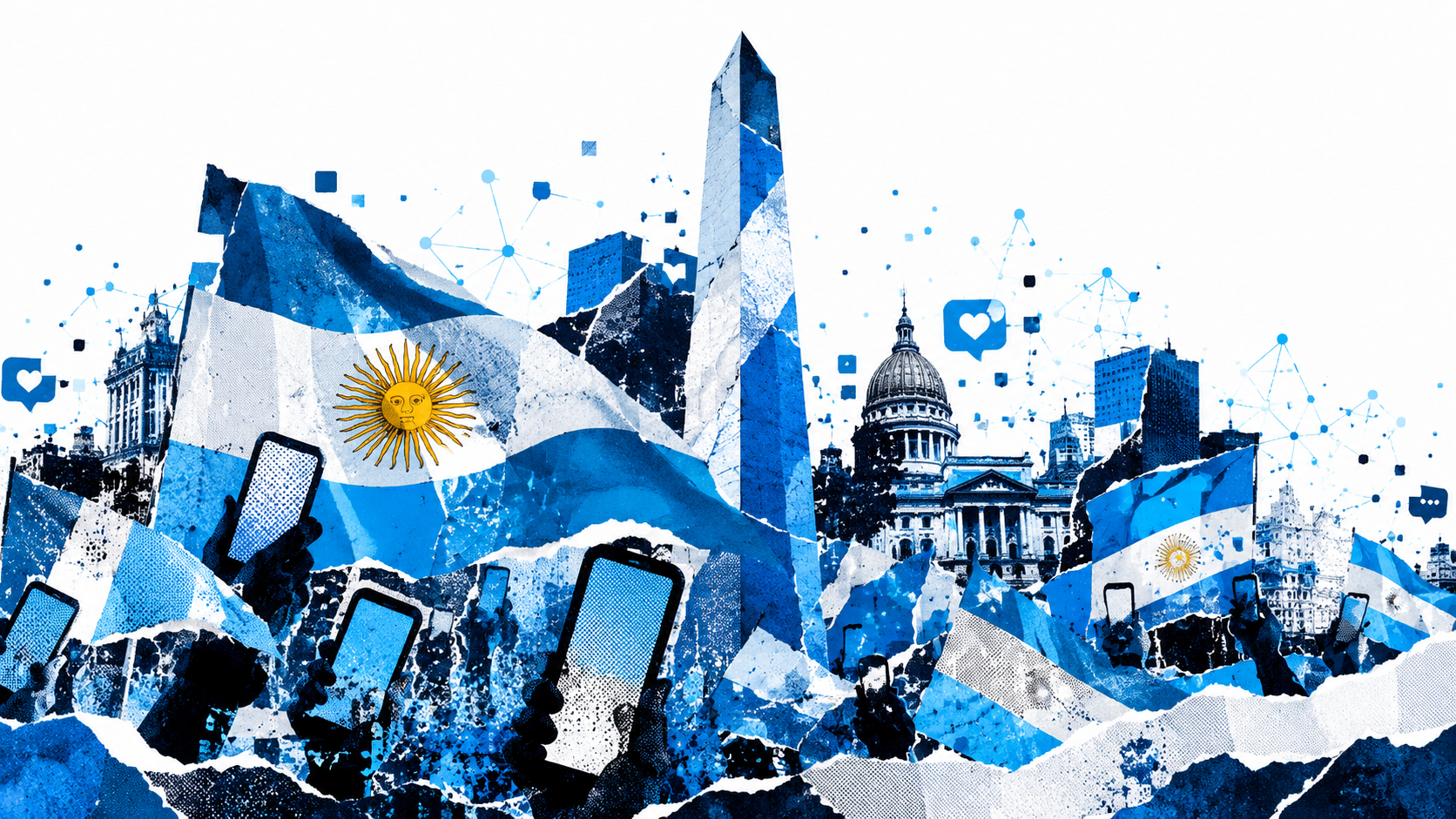
Argentina and the New Albiceleste Youth: The “Digital Fatherland”
Argentine youth know they love the country, but they do not know what kind of country they want or can have.
https://conciencia-democratica.org/articulos/argentina-y-la-nueva-juventud-albiceleste-la-patria-digital?lang=enBy Felipe GalliAugust 9, 202633 min read
In-depth reading
The recent clashes, confrontations and outbursts on social media that occurred during the 2026 FIFA World Cup, together with other relevant factors, have left Argentina on the brink of a new generation of young people who will vote for the first time in 2027. This generation will be united by a “trench patriotism” against external xenophobic aggression, yet still deeply divided regarding its political, economic and social future.
On October 31, 2012, Argentina expanded its democratic participation with the enactment of Law 26.774 or the “Youth Vote Law,” which lowered the voting age from eighteen to sixteen, applied from the 2013 legislative elections and in every subsequent election since then. This event, defended at the time as a step toward inclusion, appears at first glance to be an innocuous factor in the subsequent political trajectory (marked by the worsening economic and currency crisis, declines in the social sphere and the increase of conflict and political polarization). In reality, however, it stands as a pivotal turning point with high importance for explaining the current political situation of the country.
Fourteen years after the passage of the youth vote, amid an accelerated renewal of demographic cohorts from election to election, the explosion of social networks as an indispensable element in the lives of most people, a succession of governments denounced as failed, erratic or disappointing (in the figures of Mauricio Macri and Alberto Fernández) and the rise of disruptive forces such as the Milei phenomenon, Argentina is experiencing a very particular social phenomenon: a widespread disenchantment with political leadership and institutions on the one hand, and a resurgence of reinforcement of its national identity on the other.
The purpose of this paper is to analyze the recent history of nationalism in each generational cohort of adolescent voters from the youth‑vote enactment to the present, the impact of the eruption of social networks and globalization, the arrival of the Argentine football team as a unifying factor, and finally the recent nationalist eruption in the context of the 2026 World Cup and its possible developments ahead of next year’s electoral cycle.
We will not delve into predictions or future assertions, considering that the current situation calls for analytical immediacy regarding the phenomenon (which we will provisionally call “Digital Fatherland”) but prudence regarding diagnoses and eventual projections. With this text, the idea is to open the door to an honest discussion about the characteristics of the “new patriotism” in Argentina, its differences from the previous official discourse, and the state in which the cohort of new young voters (aged 15 to 16 at the time of writing) and the contesting political forces will arrive at the polls next year.
Characteristics and impact of the youth vote: Why talk about teenage voting?
Law 26.774 created a new age band of voters between 16 and 17 years old, together amounting to roughly one million new electors in each electoral cycle. Although their participation is not mandatory, it has been rising in recent years, approaching proportions similar to the average participation of voters of other ages. And while this is a small segment usually annexed to a much larger band (voters aged 16 to 29 constitute 24 % of the total registry), the most relevant aspect is the accelerated generation of very different teenage voter cohorts each time one follows the other.
The origin of this difference lies in the limited space of political memory that these electors have, simply because of their young age. Restricting ourselves to sixteen‑year‑old voters, we realise that in each electoral cycle the president will have to answer to voters who were only twelve when he was elected. Discounting the fact that cases of early youth politicisation are truly scarce, we can infer that these new voters have very vague memories of governments preceding the current one. Hence, the general volatility of these voters and their tendency to act more reactively than analytically is explained: their point of comparison is nil or very low.
Between economic and social variations and the accelerated changes a child experiences on the way to adolescence, young voter cohorts differ greatly from one presidential election to the next. The first teenage cohort that voted in 2015 had its immediate political memory limited to the administration of Cristina Fernández de Kirchner; the second cohort that voted in 2019 remembered the term of Mauricio Macri; the third cohort that voted in 2023 remembered the administration of Alberto Fernández (with the aggravating factor that their adolescence was marked by the social disruption of the pandemic); and the current fourth cohort, which will vote in 2027, will arrive with only the fresh memory of Javier Milei’s presidency.
The behaviour of these electors (which we will explain in more depth in the following sections) has had serious variables, but they are difficult to calculate. According to data compiled by CIPPEC/UNICEF and the CNE in 2015, only 58 % of 16‑ and 17‑year‑old voters went to the polls. No data calculate the exclusive support of this age range; they are counted as part of a larger cohort of 16‑ to 29‑year‑olds, in which majority support for Daniel Scioli’s candidacy was estimated.
The same pattern repeated in 2019, the elections that gave victory to Alberto Fernández. As in 2015, the majority of the 16‑ to 29‑year‑old cohort leaned toward Peronism, although in this case the rejection of the economic situation under Macri’s mandate and the appeal to progressive agendas then popular among urban youth (such as the feminist wave) were stronger. Likewise, the only available datum on teenage voting concerns participation, which showed a significant increase compared to 2015. A 64 % share of 16‑ to 17‑year‑old voters cast their ballot.
Finally, the youth cohort that voted in 2023 generated the most debate and, for the first time, drew attention to its electoral impact, amid the widespread consensus that young people propelled Javier Milei’s candidacy and his subsequent rise to the presidency. In this context, the teenage cohort also reached its historic participation peak: in the first round 68.6 % of eligible minors under 18 voted, less than nine points below the 77.1 % national turnout.
The analysis collides with serious difficulties derived from the scarce access to studies and analyses that focus directly on teenage voters. The difficulty of finding data disaggregated specifically for the 16‑ and 17‑year‑old cohort beyond mere participation, and the repeated tendency to group them with the “under‑30” voters, reflects a methodological neglect or blindness in recent public‑opinion research.
There are explanations for this lack of literature that make it understandable: its small size requires larger and more expensive samples; surveying minors is complicated by access issues; and the political interest in such a tiny and volatile electoral segment is scarce. Nevertheless, it is necessary to stress that, even though they represent a numerically small influence (between 2 % and 3 % of the registry), their composition and characteristics make them unmistakably different from older generations with which they are grouped.
First, because it is not possible to fine a minor, teenage voting in Argentina is not compulsory but optional. This from the outset implies a substantial difference between adult voters and minors and has been reflected in the fact that their participation is always below the national average, despite a rising trend.
Second, the teenage voter (by virtue of being a minor) has a far more restricted space for political socialisation than a voter over 18, limited to social networks and, to a lesser extent, family influence. Moreover, these voters have a more fragmented memory of previous governments and are in a much more intense and volatile identity‑formation stage than someone only a few years older. By comparison, a 16‑year‑old voter differs much more from a 26‑year‑old voter than the latter does from a 36‑year‑old.
Finally, the behaviour of the teenage elector, if we only consider the available participation factor, shows enormous differences from that of their adult peers. While national electoral turnout has steadily declined (from 81 % in the first round of 2015 to 77.1 % in 2023), among adolescents it has risen exponentially, moving in the opposite direction of older voters. This sole datum already demands a more direct and focused study of teenage voting.
Limited as we are to the electoral data available and to the methodological difficulties of analysing phenomena such as social‑media trends and the contemporary digital sphere, we hope this essay chiefly serves to open a necessary discussion on the topic, pending richer methodological material for future research.
Patriotism, social networks and the “Ezeiza feeling”
Because Argentina is a country founded on contractualist principles and a state constituted within the nineteenth‑century liberal imagination with little or no room for closed ethnic criteria, “nationalism” in Argentina is understood as the ideological manifestation of a patriotism based on civic and cultural values, alongside identification with the State, its patriotic symbols and its external representation, whether political, social or sporting (for example, in the case of the football team).
At the moment the youth‑vote law was enacted, Argentina was undergoing a transition in how its youth identified with nationalism. Generally, a “institutional‑school patriotism” prevailed. For many Argentine adolescents, the concept of “Fatherland” was strongly associated with the flag, the anthem, the football team (which at that time was enduring a permanent drought of successive defeats) and education, as well as nostalgic references from adult family members (Maradona, the Malvinas, democracy, the 1‑to‑1 in the 1990s). It was more a “patriotism of duty” than a genuine nationalist fervour, although some sectors were indeed inclined that way.
Meanwhile, the 2010s brought a digital revolution that pulled millions of Argentines (especially from middle and lower‑income sectors) out of international isolation. According to INDEC studies, in 2011 only between 42 % and 45 % of Argentine citizens had continuous internet access. In the following years that percentage rose to 56 % in 2015 (at the end of Cristina Fernández de Kirchner’s term) and to 62 % in 2019 (at the end of Mauricio Macri’s term).
Soon after, the eruption of smartphones and the forced digitalisation during the pandemic accelerated a massive democratisation of the Argentine digital sphere, and by the end of Alberto Fernández’s term, UNICEF data showed that more than 93 % of urban households had mobile or fixed internet access, while over 96 % of adolescents accessed some form of digital consumption. This reached youths in far‑more remote interior regions and inhabitants of socially marginalised sectors such as emergency settlements, albeit with obvious differences in access and consumption.
This massive internet access eliminated or weakened class‑ or region‑based barriers in many adolescents’ consumption, while facilitating the diffusion of narratives commonly labelled “globalist”. Influencers, pop‑culture stars, visual content, and an increasingly entrenched use of social networks as the primary information source—far above traditional media—became dominant.
The overwhelming majority of Argentine adolescents gaining access to external material and easy contact with peers abroad considerably reduced the influence of their family and school base during the late 2010s, up to the pandemic’s arrival in 2020, when virtually all socialisation outside the home became digital, entailing an even sharper generational gap between the 2015/2019 cohorts and those of 2023. Adolescents who voted in 2023 not only had very limited memories of pre‑Fernández governments, but their recollections of life before the pandemic were essentially child‑like.
In addition to replicating consumption patterns from other countries and obtaining massive information access (beyond each case’s limitations, nuances and caveats), adolescents could also contrast their reality with perceived realities elsewhere. This was compounded by the deterioration of the country’s economic situation that led to the 2018 currency crisis, later aggravated by pandemic‑related inflation spikes.
Although many aspects of that residual institutional‑school patriotism persisted and continue to be highly present among Argentine youth (and the feeling of “national pride” has always been a majority in purpose‑built surveys), the economic situation and the contrasts weakened the image many held of the country, a phenomenon that placed them as protagonists while also affecting the broader population.
In 2010, a University of Palermo poll together with TNS Gallup found that 94 % of respondents considered themselves “proud” or “quite proud” of being Argentine. By 2016, at the Bicentennial of Independence and during the early months of Mauricio Macri’s government, another poll—this time by the National University of Tres de Febrero through CINEA—revealed that 65 % of Argentines felt “very proud” of their nationality, while 19 % were “somewhat proud”. Only 8 % reported being “a little proud” and a modest 5 % “not proud at all”.
By 2023, months before the primary elections, a new poll by Delfos showed that the percentage of Argentines declaring themselves “very nationalist” hovered around 58 %, “somewhat nationalist” at 19 % and “not nationalist” at 10 %. The difference lay in the age breakdown: respondents aged 18 to 29 (among whom the teenage electoral cohort of 2015 and 2019 would fall) were the least nationalist, with “not nationalist” reaching 23 % among them.
Again, facing the methodological gap of youth surveys, the rise of less “patriotic” political options and the shift in political discourse toward more “globalist” positions became evident during this period. While this is clearer from the anti‑Peronist side (from the “opening to the world” thesis defended by Macri to the aggressive and sometimes exaggerated alignment of Milei with US Trumpism), it was also present in Peronism, with a more decisive appeal to global progressive agendas (such as defending feminism and LGBT rights) that, in parts of Alberto Fernández’s government, acquired an almost core character in his discourse, which even drew criticism from more conservative and “orthodox” sectors of his base.
Against this backdrop, during the pandemic period and ahead of the 2023 electoral cycle, the “Ezeiza feeling” began to emerge among many Argentines. According to various polls over recent decades (through Statista and Voices! measurements), the desire to emigrate rose continuously from 2007 to 2022, reaching peaks of 40 % to 50 % in some pandemic‑era measurements. Among surveyed youths aged 16 to 24, the intention to leave the country sometimes surpassed 60 %, before dropping during the early years of Milei’s administration. Regarding social networks, the slogan “the exit is via Ezeiza” repeatedly trended, and during Javier Milei’s campaign the phrase “Milei or Ezeiza” was invoked several times.
With the available data, one can generally suppose that, particularly for youth, Argentina finished the pandemic with its national identity subjected to a growing questioning between learned cultural identification and harsh pessimism about the country’s future.
The Albiceleste, the Scaloni‑Messi phenomenon and the non‑political patriotic resurgence
In July 2021, after twenty‑eight years, the Argentine national team captained by Lionel Messi and directed by Lionel Scaloni won its sixteenth Copa América, ending a long football drought for “the Albiceleste”. That triumph raised expectations for what would later become its definitive coronation: the victory at the December 2022 World Cup, which marked Argentina’s third triumph in the tournament and the first in more than thirty years.
Despite historic attempts to capitalise Argentine football politically and an invariably close link between football and politics for cultural reasons, the general relationship between the team’s sporting trajectory and the country’s political destiny has been negligible. That does not mean that individual players’ actions or the impact of a win or loss on social mood lack relevance.
On December 20, 2022, the champion squad returned to Argentina and was greeted by the largest street demonstration ever held in the country’s history, estimated at five million Argentines covering the Greater Buenos Aires area. That crowd was more than double the gathering on June 20, 1973, when Perón returned from exile, which had held the previous record. Occurring amid marked political tension, it is fair to say that no moment in Argentine history could have produced (and it is unlikely to ever again produce) a unity display comparable to the popular celebration of the Qatar triumph.
Historically, the football team has served as a unifying symbol for many Argentines above political fissures, albeit with clear caveats and nuances. One such nuance has always been the permanent comparison between Diego Maradona (known for his controversial public political opinions and representation of marginalised sectors) and Lionel Messi (seen more as an exponent of less politicised, middle‑class circles), as well as the criticisms from more militant Kirchnerist sectors toward players deemed “lukewarm” or outright “traitors”.
From this perspective, some argue that Maradona’s 1986 triumph (especially the two goals against England a few years after the Malvinas War) and Messi’s 2022 victory are hardly comparable in symbolic, social and political impact. Yet to suggest that the Scaloni‑Messi duo therefore failed to leave an interesting national myth for the country would be erroneous.
The successive victories of Messi and Scaloni in Brazil and Qatar occurred amid the peak of the patriotic sentiment described earlier, with an overwhelming share of people wishing to emigrate and a permanent discontent with the political class, the economic situation and the social fabric. Regarding Scaloni, the coach had assumed his role on an interim basis in 2019 and had faced a fierce media offensive in his early years due to his lack of experience. Concerning Messi, by contrast, a half‑decade of decisive club triumphs abroad, coupled with a series of defeats and missed finals with Argentina (especially in the 2014‑2019 cycle), seemed to reinforce the widespread thesis that “the Argentine does better when he leaves”.
In that context, seeing Messi lift the World Cup and Scaloni become the most successful coach in the team’s history broke a long series of myths and taboos. From being a symbol that “even the best lose” and that “the Argentine succeeds abroad”, Messi now represented perseverance, achieving his greatest sporting triumph in the autumn of his career. Scaloni, once a total unknown “without experience”, now stood as a symbol of the capacity to “close mouths against all odds”. Two symbols of individual success rather than national triumph, yet success nevertheless.
The political linkage of the team and the continued reticence of its players to express direct positions on national issues (outside of isolated statements) generated some commentary and criticism. From the Kirchnerist side, the lack of positioning was often taken as a de‑facto opposition stance, stemming from the squad’s refusal to celebrate from the balcony of the Casa Rosada with Alberto Fernández—a gesture reminiscent of those in 1978 and 1986. After Milei’s victory and the new triumph of the team in the 2024 Copa América, some analysts and opposition figures on social media began to view “the Albiceleste” as a social distraction factor favourable to Milei.
Thus, ending 2025 with a ruling‑party win in the mid‑term legislative elections, a legislative triumph for Milei (aside from defections within the Justicialist Party and internal opposition struggles over the 2027 presidential candidacy) and a “dimmed” social atmosphere ahead of the 2026 World Cup, the situation seemed to point to this “national unifying factor” dissipating.
The 2026 World Cup: Sporting suffering and the “anti‑Argentine campaign”
Argentina entered the 2026 World Cup as the reigning champion, slated to face Algeria, Austria and Jordan in the group stage. In the pre‑World‑Cup period, and especially after the first match against Algeria (a 3‑0 victory for Argentina with a goal disallowed for the Arab side), the first messages of what would later be seen as a harsh eruption of public hatred on social media began to appear (later moving beyond the digital sphere), initially targeting the Argentine team and later the country itself.
In the following weeks, numerous accounts dedicated to sports dissemination began sharing clips of the Argentine team’s matches, framing events to suggest an arbitral bias favouring the Albiceleste. Soon after, a political conspiracy (given the solid alignment of Javier Milei’s government with Donald Trump’s, which presided over the host nation) and finally a racial theme (the persistent agitation of the “racist Argentina” thesis, historical distortions, the “black genocide” myth and the amplification of certain behaviours by Argentine fans) were spread by European and US activists.
As the tournament progressed, with the Albiceleste comfortably passing the group stage but later surviving on the brink of elimination with great suffering in subsequent matches (Cape Verde, Egypt and Switzerland), virtual attacks against the country multiplied. A negative comment about Argentina on platforms such as X (formerly Twitter) could easily reach a million views and hundreds of thousands of likes. The peak came from the historic match against Egypt, in which Argentina overturned a 2‑0 deficit in the final fifteen minutes to win 3‑2. Many of these accounts amplified the heated statements of Hossam Hassan, Egypt’s coach, who protested—without evidence—what he considered an arbitral manipulation against him.
Within days, the aggression toward Argentines spread to digital terrains far removed from sport, with emphasis on spaces like X and Reddit. In fandom groups that united fans of K‑Pop stars, anime series, digital art and a long list of globalised environments, Argentine teenagers were expelled or harassed, forcing many to build their own support networks. Violent memes, malicious comments and, eventually, attacks on Argentine establishments in specific countries went viral, reaching several million interactions. For many young Argentines from diverse communities, what had been a safe refuge in their digital sphere turned into a constant battlefield.
The purpose of this text is not to judge the truthfulness of the “anti‑Argentine campaign”, which currently fuels deep and polarising debates. However, we will operate under two assumptions that can be consensually accepted: 1) the excessive digital aggression toward Argentine users did occur; 2) the main victims of these aggressions were Argentines with a more fluid digital life. The focus of the analysis therefore lies on the latter point. Argentine teenagers were, consequently, the most affected by what happened.
According to a poll conducted by consultancy Trespuntozero, 79.1 % of Argentines believe a campaign against the country exists, while 69.2 % think it was organised from abroad. Faced with this sense of collective aggression toward the nation, one can perceive the emergence of a new phenomenon: “trench patriotism”. The nationalist sentiment no longer stemmed from an institutional‑school replica, nor from the exaltation of a specific political movement, nor even from the shared feeling of a football shirt, but from a direct reaction against what was perceived as external aggression.
Part of that reactive wave included organising groups to denounce xenophobic incidents abroad or to report xenophobic content on networks, up to attempts to organise “shaming” actions against foreign residents in Argentina who reproduced perceived negative content about the country or (to a lesser extent) who publicly supported the Albiceleste’s sporting rivals.
In this context, Argentina reached the semi‑final against England on July 15, a match laden with obvious historical implications due to the Malvinas sovereignty dispute. The event, preceded by a series of controversies over banning fans from displaying material alluding to the diplomatic conflict between the two nations, concluded with a historic moment when the players themselves raised a banner bearing the inscription “Las Malvinas son Argentinas,” garnering solid domestic support and amplifying the political, social and digital issues surrounding the event.
The players’ actions at the end of the match (which included footballers with careers in English clubs and sparked calls for expulsions or sanctions in Britain) shattered the myth of an “apolitical” team. The Messi/Scaloni phenomenon ceased to represent merely an example of individual success or simple sporting symbolism and adhered to the effect of “trench patriotism” that much of Argentine youth was experiencing at that moment.
Despite the defeat in the final against Spain, the 2026 World Cup ended up having a much deeper impact on the nationalist conception within the country. Even the defeat itself marked a new step for the cohort that will vote in 2027. Most of them have spent more than half their lives, from childhood onward, never seeing the team lose a key international tournament. With the end of the football‑victory cycle, renewed patriotism may naturally transition to other spheres.
Political impact: No clear beneficiaries
Beyond the sporting realm, the total political impact of the new “trench patriotism” can only be fully assessed over time (whether it translates into something tangible that influences elections or dissipates). Nevertheless, clear signs emerged during the World Cup itself, and a clear example is the debate over the Law on the Inviolability of Private Property, promoted by Milei’s government, which obtained a mid‑senate sanction a few days after the tournament but faced harsh amendments largely derived from what happened.
The government had been pushing this legislation for months, which included an almost‑complete repeal of the 2011 Land Law (which limited foreign ownership of productive lands), a modification of the Fire‑Management Law (allowing earlier land‑use changes after a fire), and the acceleration of forced evictions.
While the ruling party’s legislative strategy over the past three years has involved presenting very ambitious projects and tolerating their “pruning” to allow the approval of more modest but “urgent” measures, the negotiations aimed at the desertion of Peronist senators after the ruling‑party win in 2025 and the string of legislative triumphs in the early months of the year—plus an increasingly apathetic social mobilisation due to the opposition’s internal crisis—would have allowed the government to pass the full law.
The debate was scheduled for July 16, just one day after the semi‑final. However, the players’ action of raising the Malvinas banner and the reaction on social media frightened sectors in the Senate’s “dialoguist” block, with some legislators retracting their support for the law only hours before the debate. On that same July 16, the ruling side had to request an interim recess until August 6, seeking to “kick” the debate to after the World Cup.
Facing the renewed nationalist impulse, the political cost of approving the foreignisation of lands increased considerably. The government’s displeasure with the team’s gesture was evident in the tensions between the ruling side and the AFA in the days before the final, with Milei commenting critically on the players’ action in an interview, and later publicly stating that, had Argentina won, the squad would have refused a meeting at the Casa Rosada as it did in 2022.
When the debate resumed, on August 5 the ruling side was forced to completely withdraw the chapter concerning the Land Law reform. The next day, during the session, it also eliminated the chapter on post‑fire land‑use changes. The project ultimately obtained a narrow mid‑senate sanction of 37 votes to 33.
The episode is relevant because of the lack of capacity of political forces to appropriate nationalism. From the ruling side, Milei was leveraging the “anti‑Argentine campaign” impulse to try to impose an identity‑based ideological agenda, accusing the Brazilian government of being behind the attacks on networks and decreeing the expulsion of foreigners who insulted the country or its patriotic symbols. Meanwhile, Peronism attempted to raise the banner of national‑sovereignty defence, but the debate process (including the conspicuous absence of Kirchnerist Anabel Fernández Sagasti due to her pregnancy and the sterile discussions among militants and leaders) exposed a notable disconnect between Peronist leadership and today’s Argentine youth.
In sum, the wave of “trench patriotism” is characterised—besides its increasingly transversal nature—by its political orphanhood. Polls continue to show a strong public rejection of traditional political parties, while at the same time a constant pessimism about the country’s economic future under Milei’s government. Conversely, opinions on the team’s conduct during the World Cup reflect overwhelming approval, with support ranging from 66 % to 83 % depending on the pollster. The “Albiceleste wave” managed to generate enough street power to trigger a legislative stumble for the government. Yet, opposition leaders found themselves disconnected from a protagonistic role, operating solely as an institutional veto spring.
Ruling versus opposition: A deferred patriotism
The “trench patriotism” phenomenon was highly transversal, with its epicentre among the youth and its greatest consequences for the adolescents who will vote for the first time in 2027. Nevertheless, it is important to note that this patriotism is deferred by obvious ideological, class or regional nuances that never fully disappear. Regarding potential political impact, we can group the two visions of the “new patriotism” into two portions: the ruling side (aligned with Milei’s government discourse) and the opposition (today politically headless but with probable voting expressions between Peronism and the left).
From the ruling side, a rhetoric emerges that reclaims the country as a bastion of Western, conservative or economically liberal ideals and rejects foreign hatred as an “attack by woke culture”. This discourse is further defined by the president’s own statements, with diplomatic consequences (such as the relationship with Brazil).
From the opposition side, the rhetoric involves denouncing an aggression by foreign powers whose aim would be to “dominate” the country, emphasising powers like the United States and Israel and, to a lesser extent, Europe. In this sense, the opposition portrays Milei’s government as a co‑conspirator in this alleged initiative and champions both the defence of territorial sovereignty and the rejection of liberal policies.
The common elements between both visions are basically the same: a claim to patriotic symbols—the anthem, the flag and the football team—and a conspiratorial appeal to an “organized external aggression” against the country. However, the differing political framing (both in economic/institutional terms and in the construction of the “discursive enemy”) nullifies any unified understanding.
From an opposition perspective (and with greater harshness from a Peronist stance) it is easy to dismiss the nationalist discourse as a libertarian‑origin performative patriotism used solely to justify the government. Likewise, from the ruling perspective the opposition discourse has already been disqualified as an exaltation of Kirchnerism or Peronism (often naïvely, when speaking of voters who were children during the last Peronist government).
But despite the considerable differences in discourse, ideas and the level of genuine commitment of these new voters in their two major variants (ruling and opposition), regarding youth it is possible to perceive that they stem from the same underlying phenomenon: the increase of self‑identification with patriotism compared with the more globalised previous generational cohorts.
Towards 2027: Who could capitalise on it?
Facing a possible electoral process, analysing the potential actions of the 2027 youth cohort is extremely difficult—if not impossible—given the distance (more than a year away from the next election) and the general volatility.
Therefore, the most one can do is study which factors favour and which factors hinder the main political forces of the country. For space and uncertainty reasons regarding possible candidacies, we limit ourselves to four: Milei, Peronism, potential third forces and the left.
Milei and the libertarians:
- Pros: The ruling side enjoys, by far, the most seasoned structure in the realm of social networks, at least today. Its ability to reach younger electors was key in the 2023 and 2025 elections and, while a certain erosion of the voter base that brought Milei to the presidency is perceived, most polls consider that the president still retains significant support among young voters, alongside the traditional anti‑Peronist backing. His appeal to a “performative nationalism” based on migratory restriction or symbolic exaltation of certain measures could favour him among youths whose patriotism is more explosive than a complex nationalism.
- Cons: In 2023, Milei benefited from the eruption of a youth cohort influenced by rejection of the established political class, high inflation and the collapse of nationalism or its diminished relevance compared with immediate socio‑economic concerns. Four years later, he will face a new cohort whose dominant political memory is his own government and vague recollections of Alberto Fernández’s term, with difficulties retaining the previous cohort and, after administering the country for four years, the novelty‑politics boost from the prior cycle will have been spent. If a marked change in the social situation does not occur in the coming months, many young voters are likely to react with a “protest vote” out of immediacy, similar to what his two immediate predecessors experienced. The appeal of a negative past or a complicated legacy is negligible among voters who do not remember it. Moreover, many ruling‑side social‑media agents exhibit an aggressive, violent tone that can repel these new voters. Trying to “kuka” a teenager who was only twelve when Milei was elected shows the government’s inability to accept criticism, which could complicate matters with more “rebellious” electors.
Peronism:
- Pros: Peronism has a solid record in handling nationalist discourse, which has been an immovable pillar of the movement since its emergence in 1945. One of the main factors explaining the political space’s survival despite constant contradictions, discourse changes and chaotic leadership turnovers has been its ability to mimic the current national identity (constant appeal to patriotic symbols and strong adaptability to the winds of the moment, elevating history and national causes). Its discourse of defending natural resources, territorial sovereignty and social rights, as well as its possible differentiation from the international left (which at other times was a burden), helps it appeal to disenchanted progressive generations. Moreover, its solid political structure nationwide and the widespread belief that it is the only force capable of defeating Milei automatically assembles the opposition vote.
- Cons: Peronism’s skill in handling nationalist discourse clashes with its weariness and demonstrated inability to appeal to young electorates, as seen in the most recent campaigns. Poor social‑media strategy, a paternalistic tone and the exaltation of symbols or leaders who have little relevance for youth create a disconnect. For many adolescent voters, Perón and Evita are prehistory, and Néstor and Cristina are “Ancient Rome”. The only real memory they have of Peronism governing is markedly negative (the Alberto Fernández administration), and while it is a vague memory (linked to childhood), Peronism arrives at 2026 showing very few steps to differentiate itself. For many voters—especially the youngest—the Peronist space is the same worn‑out, erratic and divided political arena that handed power to Milei in December 2023. It is understandable that it does not “enthuse” or “woo” them, as has been repeatedly criticised regarding Axel Kicillof and other potential figures. This undoubtedly hampers its chances of defeating a ruling side that dominates the youth discourse even in an unfavorable context.
Third dissenting candidacies:
- Pros: Although it is still very early because the re‑ordering of the political panorama for the 2027 elections has not begun, the generational gap between the cohort and the preceding presidential mandates opens the door to the emergence of another third force arising from dissent within Peronism and anti‑Peronism. Good handling of this “patriotic wave” by leaders outside the current arena and linked to provincial forces or national parties unaffiliated with the government and the main opposition could represent an opportunity window.
- Cons: From the remnants of the PRO and the Radical Civic Union to the Socialist Party or provincial Peronisms, traditional parties are the most affected by weariness and gather low confidence among the electorate. Their handling of nationalist discourse is weak, and many are perceived as “lukewarm”, “weak” or even “puppets” before more hard‑line, aggressive rhetorical positions. Many of these forces currently hold governorships and mayoralties, making them targets of direct criticism that neutralises their ability to become a “superior” alternative.
The left:
- Pros: Led by Myriam Bregman, the Frente de Izquierda has been progressing in some polls, especially among young opposition voters who view it as a more “sincere and direct” political force than Peronism. The positive image of the Trotskyist deputy has been consolidating due to the discrediting of other political forces, as well as the perception of continuity and stability of the FIT compared with other parties and coalitions. The fact that they are linked to an international movement that is not overly powerful (the Argentine FIT is by far the most electorally successful Trotskyist party in the contemporary era) can benefit them similarly to how Peronism benefits from its differences with the centre‑left internationally. In recent weeks, amid the euphoria of the World Cup and protests against the government’s legislative agenda, party figures have appealed to “nationalising” elements of discourse, such as the defence of the Malvinas cause in the anti‑imperialist vein.
- Cons: The Trotskyist and Marxist dogma of the FIT complicates its ability to appeal to a discourse based on nationalism or patriotism, placing it at a disadvantage against Peronism in an advanced electoral campaign. Many of its leaders’ (including Bregman’s) historical rejection of patriotic symbols generates sensitive records that are hard to flip. While its radical discourse may attract young voters indifferent to the viability of its proposals, the lack of a defined political programme and its refusal to adopt a more “patriotic” rather than purely “anti‑imperialist” rhetoric could end up working against it.
Conclusion
Based on the foregoing, we can conclude that, in general terms, the generational cohort that will turn 16 in the coming months and cast its first vote next year is characterised by three components that, while not providing solid data, can heavily influence its vote:
- First, economic pessimism and anxiety as a chronic element of their lives. These young people lack solid memories of a period of prosperity or stability that would allow nostalgic associations. Their childhood and adolescence were lived amid crises or economic transition.
- Second, as a consequence of the first, a permanent discrediting of traditional political discourse among them. With no one representing them, they become an ideal breeding ground for the eventual rise of disruptive options—or, even more concerning, the eruption of an anti‑political sentiment that could become radical or apathetic.
- Third, a renewed patriotism (which diverges considerably from previous generational cohorts, both politically and nationally) but that is mostly reactive (around the “trench defence of the flag against foreign attack”), divorced from politics (they owe nothing to anyone) and deferred by ideology regarding the nation (they know they love the country, but do not know what kind of country they want or can have).
It is at least fascinating to determine that the possible return of Argentines to a more “nationalist” or “patriotic” conception derives precisely from factors that were key to its decline, without extending further into the digital sphere. What once served as a connective bridge for millions of Argentine adolescents to the outside world would become the pillar of the Argentine “new patriotism”.
Many things can be questioned without concrete data (due to the lack of surveys covering this specific electoral segment and the haste of writing a quick essay on events that have just taken place). Nonetheless, the immediate political impact is undeniable, when we consider the legislative stumble of the government, the opposition’s failure to capitalise on it and the diplomatic clashes that were recorded. It is no longer a matter of questioning “what happened” and “what did not happen”, but of studying “how it affects us that so many Argentines believe something happened”.
This general overview of the events surrounding the 2026 World Cup, youth voting and the latest political developments under Milei leaves countless open questions ahead of 2027. How will these youths vote? How much will the perception of external hatred affect their desire to emigrate or stay? Which political options (new or old) can capitalise on the “Albiceleste wave”?
References
- 94 % of young people are “proud” to be Argentine (Infobae, 2010)
- Numbers on teenage voting (Chequeado, 2015, 2019 and 2023)
- Bicentennial survey: 8 out of 10 are proud to be Argentine (Infobae, 2016)
- Nationalism in post‑modern times: 23 % of youths do not consider themselves nationalist (Delfos, 2023)
- A poll asked about the anti‑Argentine campaign (Clarín, 2026)
- Is there a resurgence of popular nationalism in Argentina? (Tiempo Argentino, 2026)
- The impact of the Malvinas flag at the World Cup: a survey revealed the effect in Argentina (El Destape, 2026)
- A survey showed that two out of three Argentines think Milei cares little or nothing about the Malvinas (Data Clave, 2026)
- A survey showed how Argentines processed the World Cup final defeat: a third turned to conspiracy theories (Clarín, 2026)
Share
For Instagram: copy the link and paste it in your story or DM.
Continue with

International politics
A SOCIETY TURNED OFF BY THE LIGHT
Cuando la noche desaparece bajo el resplandor artificial, no sólo perdemos las estrellas: perdemos el sueño, la biodiversidad y la capacidad de contemplar. Un análisis de los costos invisibles de la contaminación lumínica.
Pedro Joaquin Villagra Delgado

International politics
«The Last Bullet for Democracy»: The Merz Government Faces State Elections
The CDU/CSU-SPD coalition under Chancellor Friedrich Merz, the most unpopular in recent history, confronts three decisive state elections in September 2026.
Lukas Effinger
Theory
The Revolutionary Mirage?
What happened during the uprisings of December 2010 and January 2011?
Mortadha Ghaliounji
Comments
No comments yet. Open the conversation.
Sign in to comment. Sign in