

Essay
Tunisia: The Parties Nobody Asked For
In the first part of this series on Tunisia’s transition, we examined the battle of narratives surrounding the events of 2010–2011 and how the way they were characterized helped shape the political landscape that followed. This second part focuses on one of the major transformations of that period: the proliferation of political parties.
https://conciencia-democratica.org/articulos/los-partidos-que-nadie-ha-pedido?lang=enBy Mortadha GhaliounjiNovember 17, 202615 min read
In-depth reading
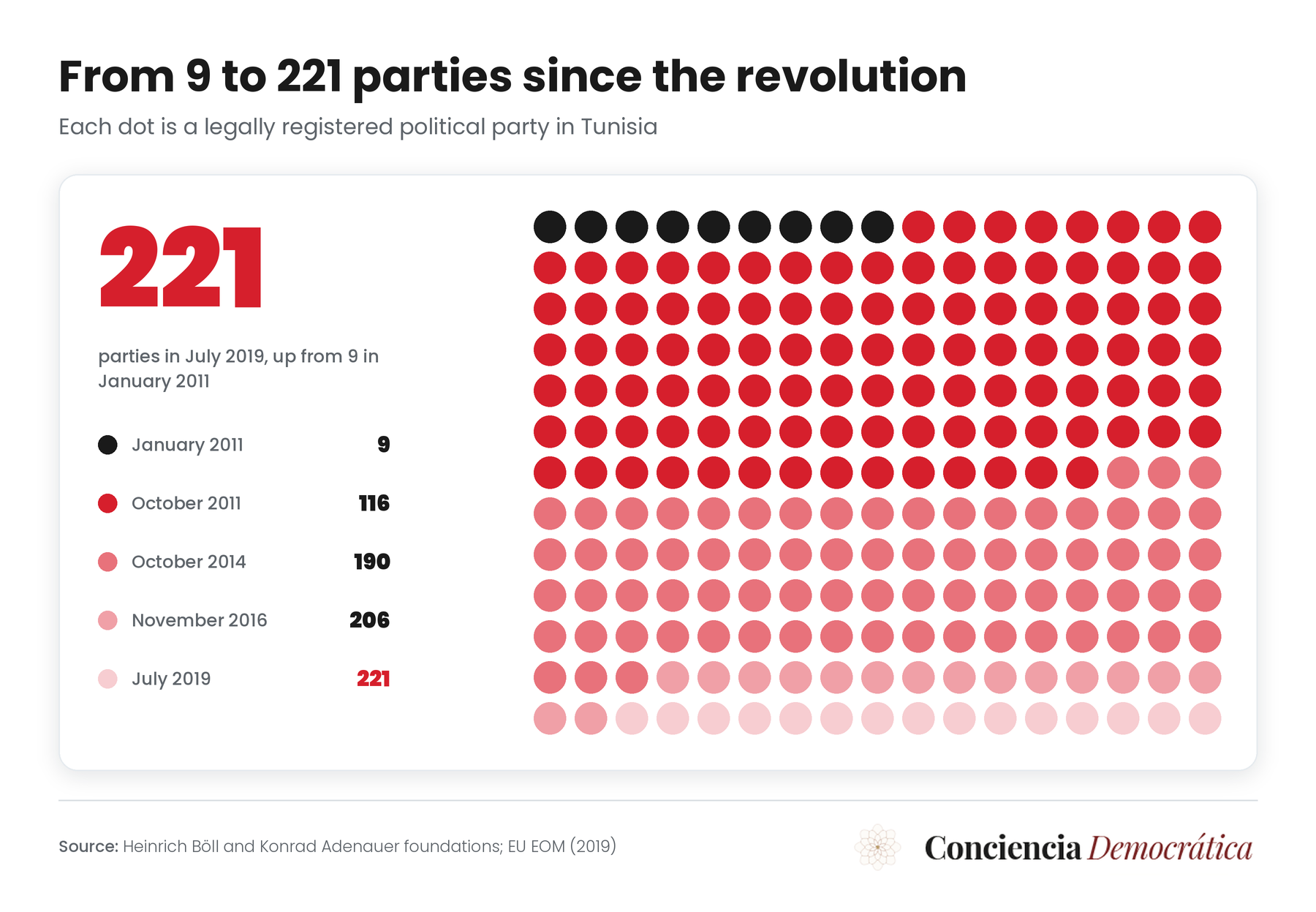
Between 2011 and 2021, Tunisia’s party landscape expanded dramatically, going from nine recognized parties in the immediate aftermath of the revolution to nearly 220 by the end of the decade.
Part of the explanation is the sudden opening of a political space that had long been locked down, in a society where public debate and competition had been stifled. But the main driver was the absence of barriers to entry. Decree-Law No. 2011-87 reduced founding a party to a simple declaration, with no minimum membership, no requirement for a territorial presence and no upfront financial threshold.
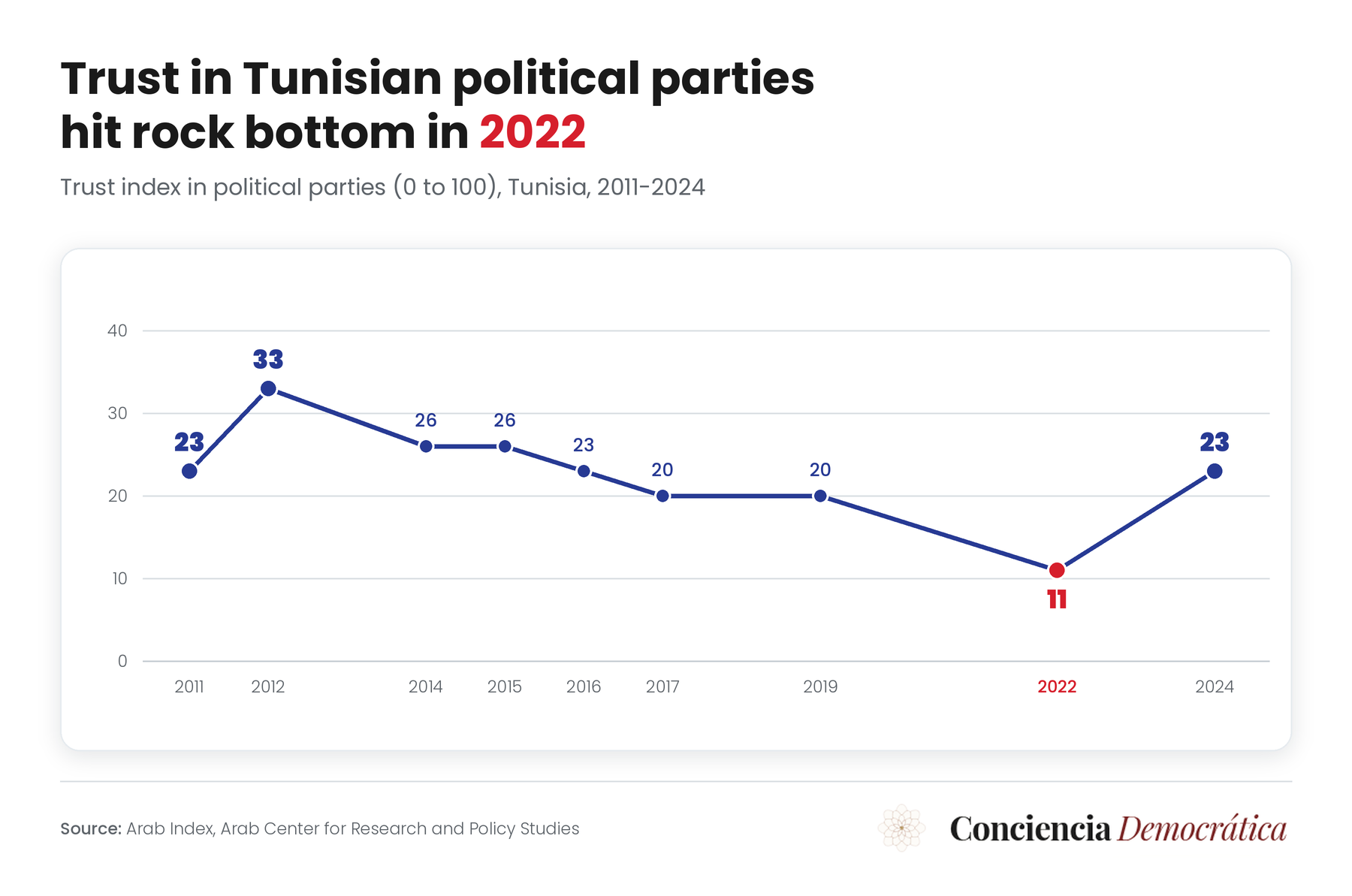
 Yet this burst of activity never seemed to find a counterpart in society. In 2022, only 11% of Tunisians said they trusted political parties, according to the Arab Opinion Index, a continuation of the distrust that marked the whole decade.
So a question arises. How do we explain the proliferation of political organizations that often answered neither an identifiable social demand nor any real collective grievance? How could these parties multiply while remaining, in the eyes of much of the population, foreign bodies in political life, empty shells or mere vehicles for private interests?
Parties Built from the Top Down
Machines Without a Base
One of the main criticisms leveled at Tunisian parties after the transition concerns how they were built. Many were assembled from the top, around a handful of political figures, with no real roots on the ground and no properly structured activist base.
Some had local branches, but these served mainly an electoral purpose: getting voters out, with no organizational or decision-making autonomy. Local sections were reduced to little more than campaign offices, while power stayed in the hands of a small circle of leaders, and sometimes of a single person in the case of “personal parties” (which Mauro Calise defines as organizations built around the leadership and image of their founder).
Politics Outside the Parties
This weak grassroots presence echoed in the 2018 municipal elections. Independent lists took 32% of the vote and won 2,373 seats, making them the leading force in the race, ahead of Ennahdha and Nidaa Tounes.
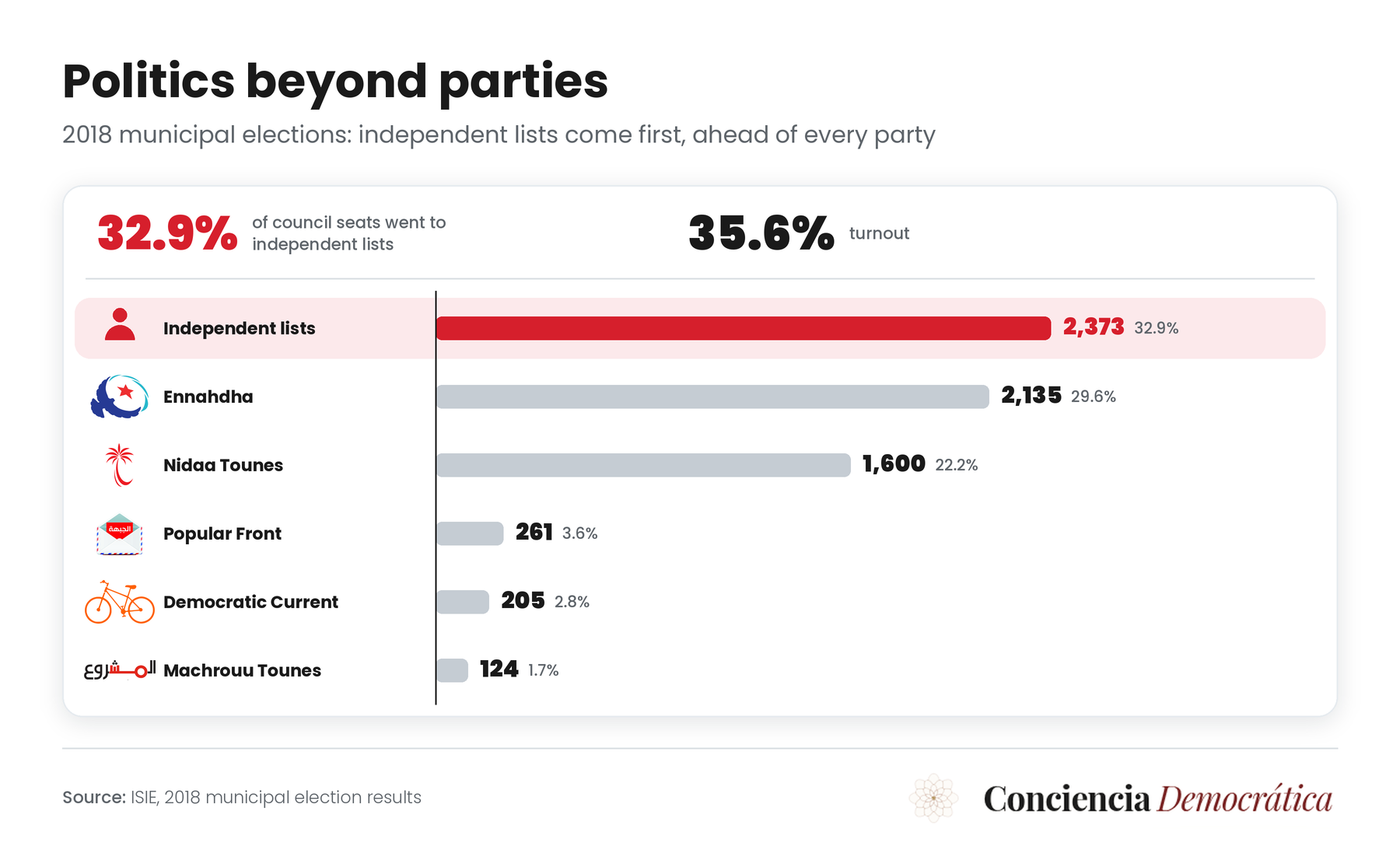 It is hard not to think of Pierre Rosanvallon’s model of “counter-democracy.” He shows that when parties sideline social issues, the people who feel neglected don’t necessarily drop out of politics. Instead, political conflict moves elsewhere, to spaces where debate is picked up by local associations, individual citizens and new interest groups organized around territorial demands.
The El Kamour movement is almost a textbook case. Young people mobilized around shared demands and built their own forms of organization, outside any party or union oversight, mainly through sit-ins and regular blockades.
Rewarding Opportunism
The transition also produced cartel parties (in the sense of Richard Katz and Peter Mair: groups that cooperate at the top and rely on state resources rather than on a membership base). Their strategies sometimes amounted to locking up the political game through deals struck among ruling elites.
The consensus between Ennahdha and Nidaa Tounes (2014–2018) is the clearest example. The creation of Tahya Tounes around Prime Minister Youssef Chahed (2016–2020), built on networks from within the state apparatus, follows the same logic.
Alongside these come label parties, catch-all organizations (Otto Kirchheimer’s term for parties that give up representing a particular ideological segment in order to appeal to as many voters as possible) and opportunistic mergers, often thrown together in a rush as elections approached, in the hope of winning a few seats and not always built on any real political project.
The Label Waltz
This pattern runs through the successive reshuffles of the party landscape. Beyond voters’ anger at the political, economic and social record, it also stems from the electoral system: regionalized proportional representation by largest remainder, with no threshold. That system let small parties keep getting into parliament, and it made punishment votes easier, something solidly rooted local parties might have contained better under a single-member system.
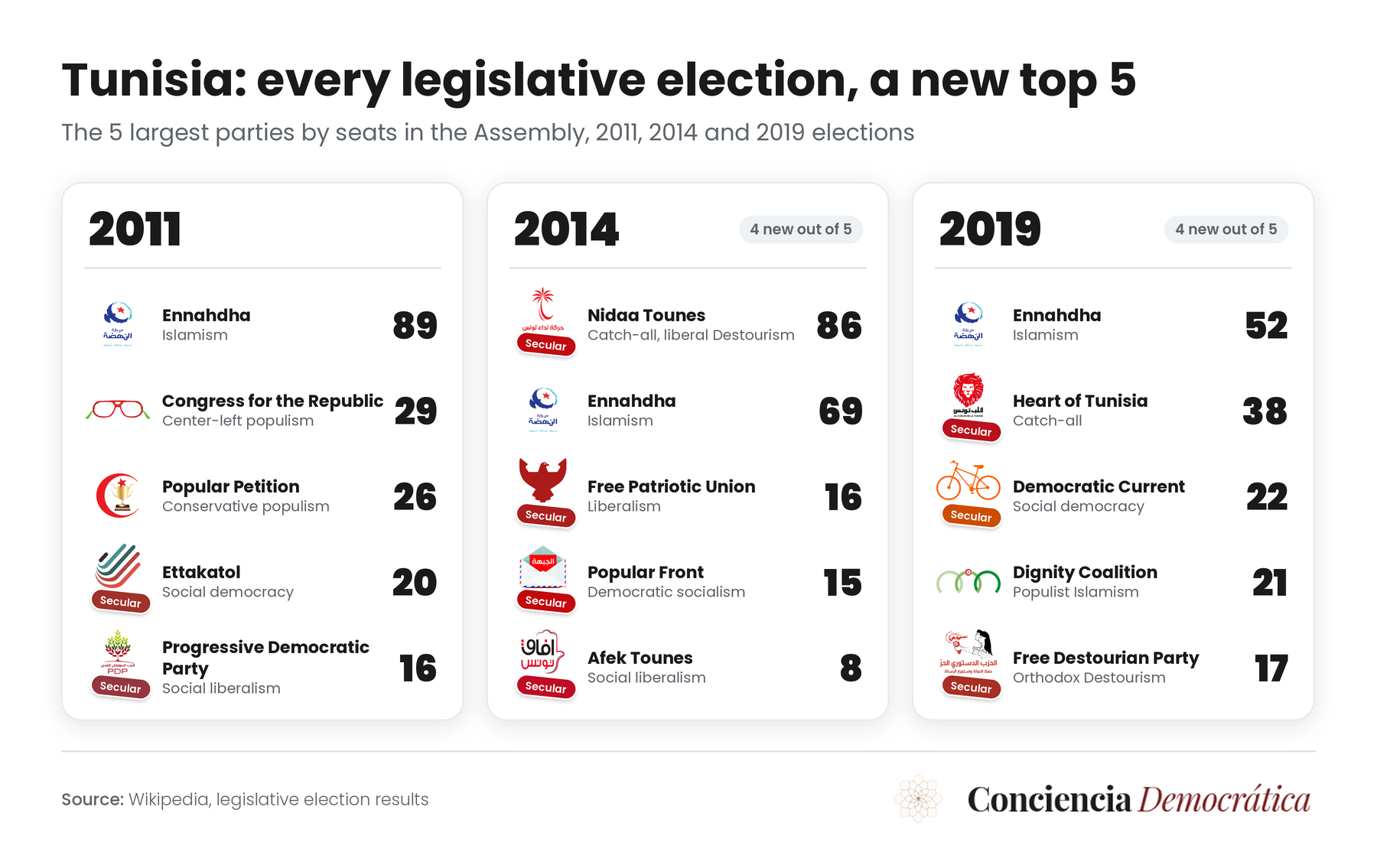 In the early years of the transition, the best-placed formations were generally those that already had networks, cadres or organizational experience from the old regime. That was the case for Ettajdid, the PDP, Ettakatol and the CPR, but also for Ennahdha, whose organization had survived decades of underground activity and exile.
From 2014, the landscape shifted with the rise of Nidaa Tounes. The party owed its success to the personality of Béji Caïd Essebsi and to its ability to bring together Destourians, trade unionists, socialists and centrists in a common opposition to Ennahdha. It also benefited from former cadres and networks of the old regime.
Other parties were built on different logics. Slim Riahi’s Free Patriotic Union is an example of a liberal “business party,” built on its founder’s money and personal resources. Afek Tounes, also liberal, took a very different path, trying to build a party with real internal structures: elected bodies, regular congresses and a network of local branches.
The 2019 elections simply extended this endless cycle of reshuffling. Al Karama appeared to the right of Ennahdha, and the Free Destourian Party entered parliament, openly claiming descent from the former single party, while Attayar and the Echaab Movement kept growing.
Amid this constant churn, Qalb Tounes, born from the breakup of Nidaa Tounes, revived the business-party model, mixing media resources, personal interests and populism around the figure of Nabil Karoui.
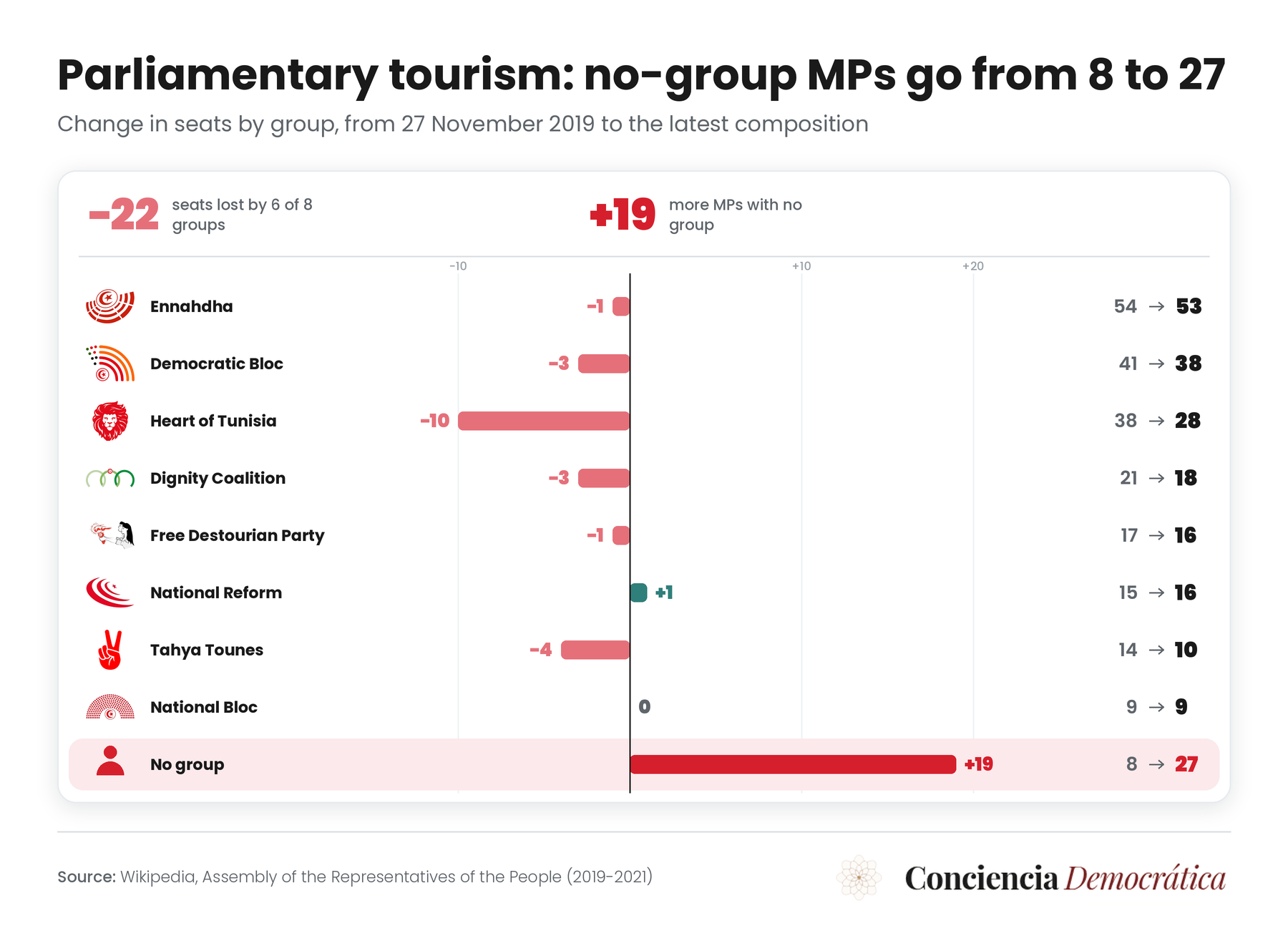
This unstable supply of parties led to remarkable mobility among elected officials, with a steady stream of changes in affiliation and moves between parliamentary blocs. The phenomenon, known in Tunisia as “parliamentary tourism,” further weakened the cohesion of political formations.
 It would be going too far, though, to say that every party and coalition to emerge from the transition lacked genuine activist roots or local structures. The components of the Popular Front, notably Watad, the Echaab Movement and the Workers’ Party, showed that they had activist bases and local relays, despite limited resources and a mobilizing capacity that didn’t always match their reach on the ground.
The same goes for the PDL and Ennahdha, which in many respects were the two most fully developed mass parties in Tunisia.
Parties Without a Society
The Myth of Economic Silence
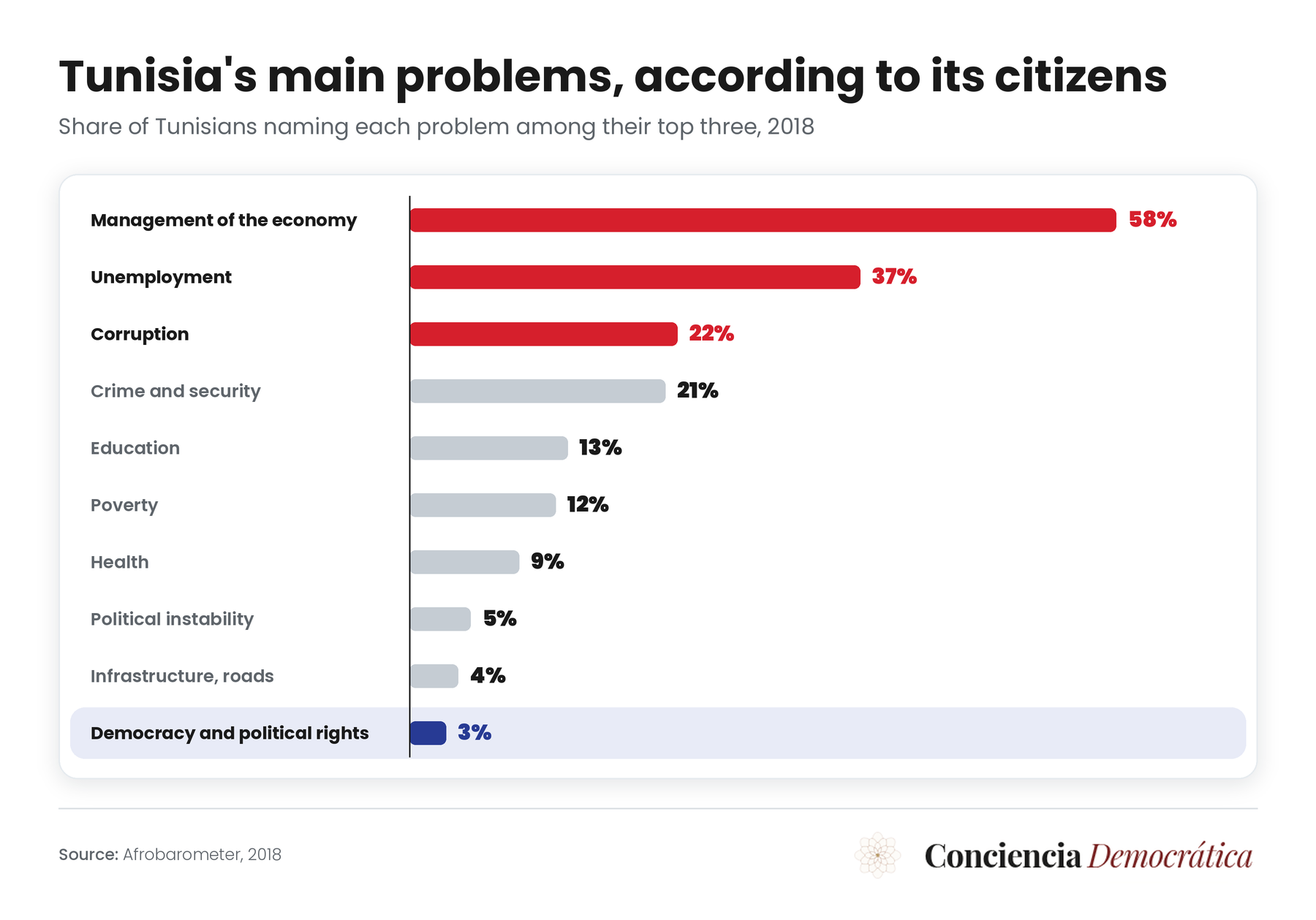
Some simplistic analyses have claimed that Tunisian parties neglected economic and social issues in favor of political and cultural ones. Yet, as many polls showed, those cultural issues were not among Tunisians’ main concerns, which centered on security, purchasing power, public health, unemployment and the deficit.
 But the premise is shaky. The parties did not really abandon economic concerns or social demands; they wrote them into their platforms. The paradox lies instead in how similar their proposals were.
As we saw in the previous installment, they all had a social dimension, sometimes a clientelist one, but they also shared several liberal orientations: strengthening the private sector, letting the market work, guaranteeing the independence of the central bank and continuing negotiations with the IMF and the reforms that come with them.
The left-wing Popular Front did defend a markedly different economic program, but it suffered from a lack of electoral credibility, partly because of a discourse seen as overly ideological, and partly because it lost its most gifted orator.
The Identity Smokescreen
With the main parties’ economic proposals so close together, the center of gravity of the debate gradually shifted to cultural and identity questions, where the differences were far sharper.
Two divides then structured the electoral contest: secularists versus Islamists in the legislative elections, and “restorationists” versus revolutionaries in the presidential race.
One could reasonably object that parties still represented voters on economic issues, and that they took up social questions that clearly held the Tunisian public’s attention, whether out of attachment, fear or rejection. The reality is more complicated.
Tunisian voters were largely at a loss when it came to economic proposals. Most didn’t read the platforms and took away only broad outlines, often generic and similar from one party to the next. Meanwhile, party leaders spent hours in the media debating identity questions, turning every line and half-word into a controversy.
With no clear economic projects to judge them on, parties were judged on their performance once in office. And successive governments largely failed to deliver, reinforcing the sense that the parties had neither the skills nor the solutions. Worse, the identity debates came to be seen as a smokescreen meant to distract from their shortcomings.
Manufacturing Nothingness
Then came the bewilderment of many Tunisians when Nidaa Tounes and Ennahdha joined forces under the banner of “consensus.” Two parties that had accused each other of seeking to impose dictatorship and spread terror suddenly found themselves allies, right after those clashes.
The alliance made the divides that had structured the electoral contest largely obsolete. Both camps now showed they could work together perfectly well despite the antagonisms they had presented as fundamental red lines.
What remained was the economy, which, as usual, turned out to be the main weak point of this government experience given its results.
Voters on both sides ended up doubly disillusioned, on cultural and on socio-economic grounds. Fear stopped being enough to get people to the polls, and the bipolar system lost its reason for being.
This shows in the breakup of Nidaa Tounes into a host of splinter groups, split between cartel parties and personal parties, and in the emergence, to the right of Ennahdha, of a movement claiming a harder Islamist line than Ennahdha itself.
Parties could no longer offer substantive representation (in Hanna Pitkin’s sense: the ability of representatives to act concretely in the interests of those they represent and to meet their expectations). Their credibility also eroded on symbolic representation, meaning their ability to embody values, an identity or collective emotions, regardless of what they actually deliver.
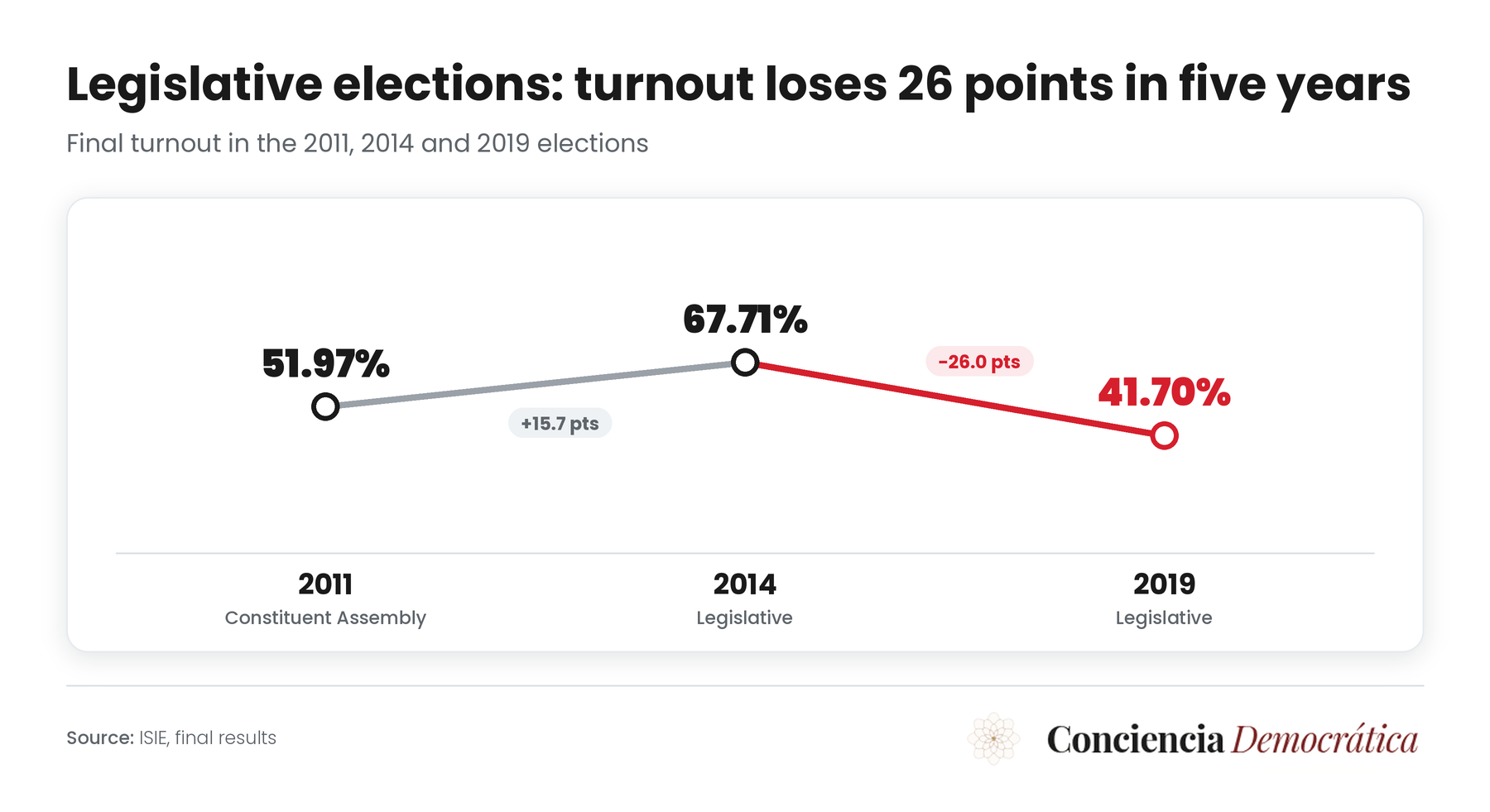
Most parties could no longer convince anyone that they embodied any real divide in Tunisian society. They left behind an ever more visible representation gap, reflected in a sharp drop in turnout, from 68.36% in 2014 to 41.70% in 2019.
 #### Stillborn Legitimacy
Another axiom needs a closer look: the idea that parties gradually lost their popularity over the course of the transition, and that exercising power earned them popular anger.
It is true that the decade cost them much of their credibility and deepened distrust toward them. But their unpopularity long predates it, and they never started from a clean slate.
According to the Arab Opinion Index, only 23% of Tunisians said they trusted political parties in 2011. Even more telling, an ISTIS-TAP poll in August 2011 found a satisfaction rate with party performance of just 7%.
 This initial distrust stems partly from the legacy of the single-party state and from authoritarian experiences across the Arab world, where the political party has often been inseparable from the state apparatus.
Tunisians were already showing a rejection of conventional parties in the first elections in 2011, when they gave a prominent place to the populist Al Aridha list, which won 26 seats in the Constituent Assembly.
After the Parties
We can therefore conclude that Tunisia did not simply suffer a crisis of its party system; the system was already fragile when it was set up. The policies of the parties that made it up only deepened its breakdown while feeding a climate of mistrust and rejection.
Despite the legal existence of a myriad of parties, the system barely managed to fulfill its core function: translating citizens’ demands and carrying them into representative institutions.
This failure, combined with a long tradition of social movements operating outside party structures, helped fuel the rejection of intermediary bodies.
President Kaïs Saïed would exploit that distrust skillfully, drawing on the generational divide and the gap between marginalized interior regions and privileged urban centers (an important divide that many parties had pushed aside), as well as on a vision of political representation free of any party mediation.
This approach led to the adoption of single-member voting for municipal and local elections as well as for legislative ones. It came with a rise in independent candidacies, both in elected assemblies and in universities, where independent lists made a notable breakthrough in 2022.
It remains to be seen whether this exit from “partitocracy” is enough to rebuild a political bond. The persistence of massive abstention in label-free elections suggests that moving beyond parties doesn’t solve the crisis of representation, but rather shifts its terms.
Bibliography
Chantal Berman et Elizabeth Nugent. Defining Political Choices: Tunisia's Second Democratic Elections from the Ground Up. Brookings Institution, Center for Middle East Policy, Analysis Paper n° 38, mai 2015.
Amel Boubekeur. « Islamists, Secularists and Old Regime Elites in Tunisia: Bargained Competition ». Mediterranean Politics, vol. 21, n° 1, 2016, p. 107-127.
Mauro Calise. Il partito personale. Editori Laterza, 2000 (rééd. Il partito personale. I due corpi del leader, 2010).
Michel Camau et Vincent Geisser. Le syndrome autoritaire. Politique en Tunisie de Bourguiba à Ben Ali. Presses de Sciences Po, 2003.
James Dennison et Jonas Bergan Draege. « The dynamics of electoral politics after the Arab Spring: evidence from Tunisia ». The Journal of North African Studies, vol. 26, n° 4, 2021 (publié en ligne en février 2020), p. 756-780.
Maurice Duverger. Les Partis politiques. Librairie Armand Colin, 1951.
Mahmoud Farag. « Mass–elite differences in new democracies: Tunisia as a case study (2010–2016) ». European Political Science, vol. 19, n° 4, 2020, p. 550-561.
Alia Gana, Gilles Van Hamme et Maher Ben Rebah. « La territorialité du vote pour l'Assemblée Nationale Constituante Tunisienne de 2011 ». Confluences Méditerranée, n° 82, 2012, p. 51-69.
Alia Gana et Maher Ben Rebah (dir.). L'émergence contrariée du local dans la Tunisie post-2011. Enseignements des élections municipales de 2018. Institut de recherche sur le Maghreb contemporain (IRMC), 2026.
Sharan Grewal. « The Dark Side of Consensus in Tunisia: Lessons from 2015–2019 ». Brookings Institution, janvier 2020.
Adrià Rivera-Escartin. « Tunisia's democratisation process: when 'consensus democracy' undermines democratic consolidation ». Third World Quarterly, vol. 43, n° 2, 2022, p. 414-431.
Jonathan Hopkin et Caterina Paolucci. « The business firm model of party organisation: Cases from Spain and Italy ». European Journal of Political Research, vol. 35, n° 3, 1999, p. 307-339.
Richard S. Katz et Peter Mair. « Changing Models of Party Organization and Party Democracy: The Emergence of the Cartel Party ». Party Politics, vol. 1, n° 1, 1995, p. 5-28.
Otto Kirchheimer. « The Transformation of the Western European Party Systems ». In Joseph LaPalombara et Myron Weiner (dir.), Political Parties and Political Development, Princeton University Press, 1966, p. 177-200.
Kevin Koehler. « Breakdown by disengagement: Tunisia's transition from representative democracy ». Political Research Exchange, vol. 5, n° 1, 2023.
Peter Mair. Ruling the Void: The Hollowing of Western Democracy. Verso, 2013.
Déborah Perez. « De quoi le consensus est-il le nom ? Négociations et interactions entre élites dans la Tunisie révolutionnaire ». Critique internationale, n° 109, 2025/4, p. 25-48.
Joshua E. Rigg. « "Why don't I forgive? They didn't ask for forgiveness!": Manich Msamah and Tunisia's Politics of Unforgiveness ». Comparative Studies in Society and History, vol. 65, n° 1, 2023, p. 167-191
Tarek Masoud. Counting Islam: Religion, Class, and Elections in Egypt. Cambridge University Press, 2014.
Rory McCarthy. « The politics of consensus: al-Nahda and the stability of the Tunisian transition ». Middle Eastern Studies, vol. 55, n° 2, 2019, p. 261-275.
Elizabeth Nugent. « Tunisia's first post-uprisings local elections are Sunday. Can they bolster citizens' belief in democracy? ». The Washington Post (The Monkey Cage), 4 mai 2018.
Hanna F. Pitkin. The Concept of Representation. University of California Press, 1967.
Valeria Resta. Tunisia and Egypt after the Arab Spring: Party Politics in Transitions from Authoritarian Rule. Routledge, 2024.
Pierre Rosanvallon. La Contre-démocratie. La politique à l'âge de la défiance. Éditions du Seuil, 2006.
Maryam Ben Salem. « "God loves the rich." The Economic Policy of Ennahda: Liberalism in the Service of Social Solidarity ». Politics and Religion, 2020.
Maryam Ben Salem. « The delegitimation of political parties in democratic Tunisia ». In Francesco Cavatorta, Lise Storm et Valeria Resta (dir.), Routledge Handbook on Political Parties in the Middle East and North Africa, Routledge, 2021, p. 165-178.
Clément Steuer. « Beyond elite consensus: did the Tunisian party system fail to channel mass polarisation? ». Third World Quarterly, 2026.
Eva Wegner et Francesco Cavatorta. « Revisiting the Islamist–Secular divide: Parties and voters in the Arab world ». International Political Science Review, vol. 40, n° 4, 2019, p. 558-575.
Décret-loi n° 2011-87 du 24 septembre 2011, organisant les partis politiques. République tunisienne.
Décret-loi n° 2022-55 du 15 septembre 2022, portant modification de la loi organique n° 2014-16 du 26 mai 2014, relative aux élections et aux référendums. République tunisienne.
Décret-loi n° 2023-8 du 8 mars 2023, modifiant et complétant la loi organique n° 2014-16 du 26 mai 2014, relative aux élections et aux référendums. République tunisienne.
Arab Center for Research and Policy Studies (ACRPS). The Arab Opinion Index.
Arab Barometer. Tunisia Country Reports.
« A un mois et demi des élections, les Tunisiens sceptiques et indécis » (sondage ISTIS-TAP d'août 2011). Kapitalis, 3 septembre 2011.
« Tunisie : Résultats définitifs du scrutin du 23 octobre » (ISIE). Babnet, 14 novembre 201.
« El Kamour : Chronologie d'une lutte ». Inkyfada, 6 octobre 2017.
« Un nouveau parti politique nommé "Front populaire" voit le jour » (recensement des 220 partis). Réalités Magazine, 22 juillet 2019.
« L'UGTE remporte les élections estudiantines » (résultats officiels des conseils scientifiques). Business News, 4 mars 2022.
Share
For Instagram: copy the link and paste it in your story or DM.
Continue with
Essay
Argentina and the New Albiceleste Youth: The “Digital Fatherland”
Argentine youth know they love the country, but they do not know what kind of country they want or can have.
Felipe Galli
Theory
From Social Democracy to the Third Way
The German SPD, the British Labour, the French Socialist Party, the Turkish CHP: one current, a thousand faces.
Mortadha Ghaliounji
Theory
Reflections on the Probationary Citizen
Algorithmic surveillance has turned citizenship into “probationary freedom,” forcing us to continually validate our identity in front of machines that cannot be reasoned with.
Mariana Puente Lera
Comments
No comments yet. Open the conversation.
Sign in to comment. Sign in